 strenos
Know your max without testing it.
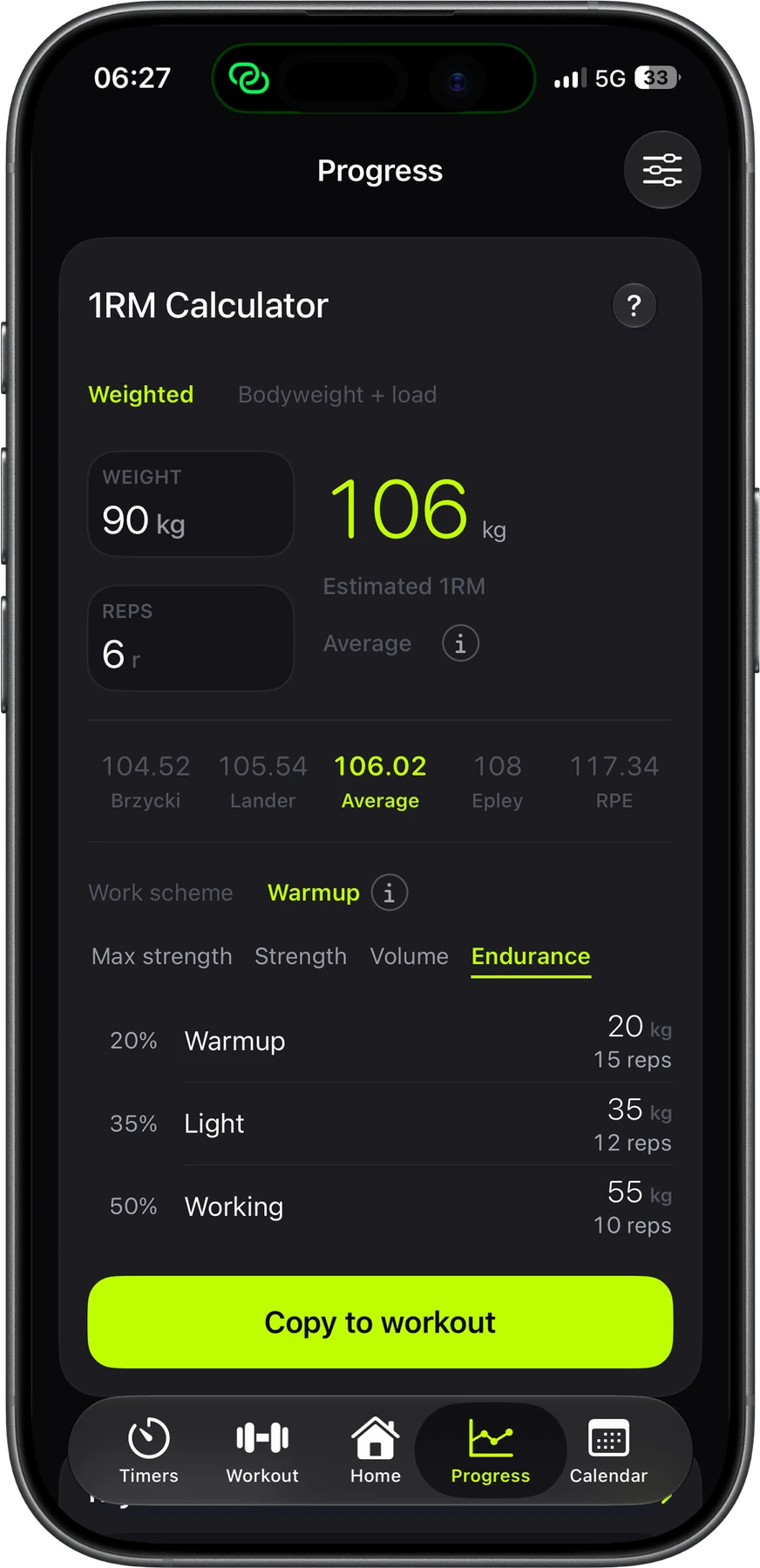
Enter a weight and the reps you got. You'll get your estimated max from three formulas, then working sets for your goal, a plate-by-plate warm-up and every percentage, rounded to your gym's plates.
- free, same formulas as the Strenos app
- kg or lb, rounded to your gym's plates
- working sets, warm-up and percentages
What to do with that max
Pick a formula and you'll get working sets for your goal, a warm-up with the plates for every step, and a full percentage table.
When an estimate beats a max test
Your 1RM is the most weight you can lift for one clean rep. You don't have to test it: one hard set of 2 to 10 reps gets you close. 100 kg for 5 works out to about 114 kg, the average of the Epley, Brzycki and Lander formulas. A real max test costs you a heavy day plus a few days of recovery, and the estimate lands close to the same number without either. Here's when to trust it and how to make it as accurate as you can.
Use it when
- You need working weights for a percentage-based program.
- You just hit a rep PR and want to know what it means for your max.
- A heavy single isn't worth the risk or the recovery right now.
- You want a warm-up that builds to today's weight, with no guesswork at the rack.
Test a real single when
- You have a meet coming up. On the platform you want numbers you've actually lifted.
- Your best set went past 12 reps. That says more about your endurance than your max.
- The lift is a weighted pull-up or dip. Use the belt calculator, which counts your bodyweight.
What to expect
- The three formulas land close together. With 100 kg for 5, they give 112.5 to 116.7 kg. Each formula runs a little high or low, and the average, 114.3, evens that out.
- Past 10 reps, only Epley is left. Brzycki and Lander were built for shorter sets, so above 10 reps they sit out, just like in the app.
- RPE sharpens the estimate. 100 kg for 5 at RPE 8 means you had two reps left. The RTS table puts that at 81.1% of your max, so about 123 kg.
- The number is a starting point. Set your weights from it, then let your real sets correct it. A new rep PR is the clearest sign your max went up.
Which formula to use
All three are classics. Choose by how many reps you did and how close to failure you went.
- 2 to 10 reps Any formula, or the average
- 11 or 12 reps Epley only
- Not to failure Add the RPE
- Pull-ups and dips The belt calculator
How to get an accurate number
- Use a hard set. The closer you went to failure, the better the estimate. An easy set of five says little about your max.
- Count only clean reps. Reps with broken form or help from a spotter don't count. If you count them, your max comes out too high.
- Aim for 3 to 6 reps. On a short, hard set it's easiest to judge how much you had left.
- Pick your smallest plate. Then the percentages and the work scheme round to weights you can actually load.
- Warm up the same way every time. Use the ramp for your goal, so your heavy sets always start from the same place.
- Recheck every few weeks. Enter your latest hard set, and the scheme keeps up with you.
How the calculator works
It runs your set through three classic formulas. Epley: weight × (1 + reps ÷ 30). Brzycki: weight × 36 ÷ (37 − reps). Lander: 100 × weight ÷ (101.3 − 2.67123 × reps). The big number is their average. Tap any formula, and everything below is worked out from that one instead.
Above 10 reps, Brzycki and Lander drop out and the estimate comes from Epley alone. The calculator stops at 12 reps, same as the app.
RPE
If the set wasn't to failure, add its RPE. RPE 10 means you had nothing left, and RPE 8 means you had two reps left. The RTS table turns reps and RPE into a percentage of your max, in half-rep steps. The calculator then divides your weight by that percentage.
Work scheme
There are four goals, the same as in Strenos. Max strength is 5 sets of 1 to 3 at 90%, strength is 5 sets of 3 to 5 at 85%, volume is 4 sets of 8 to 12 at 70%, and endurance is 3 sets of 15 to 20 at 55%. Each goal comes with its own rest time, and the weights round to the plates in your gym.
Warm-up
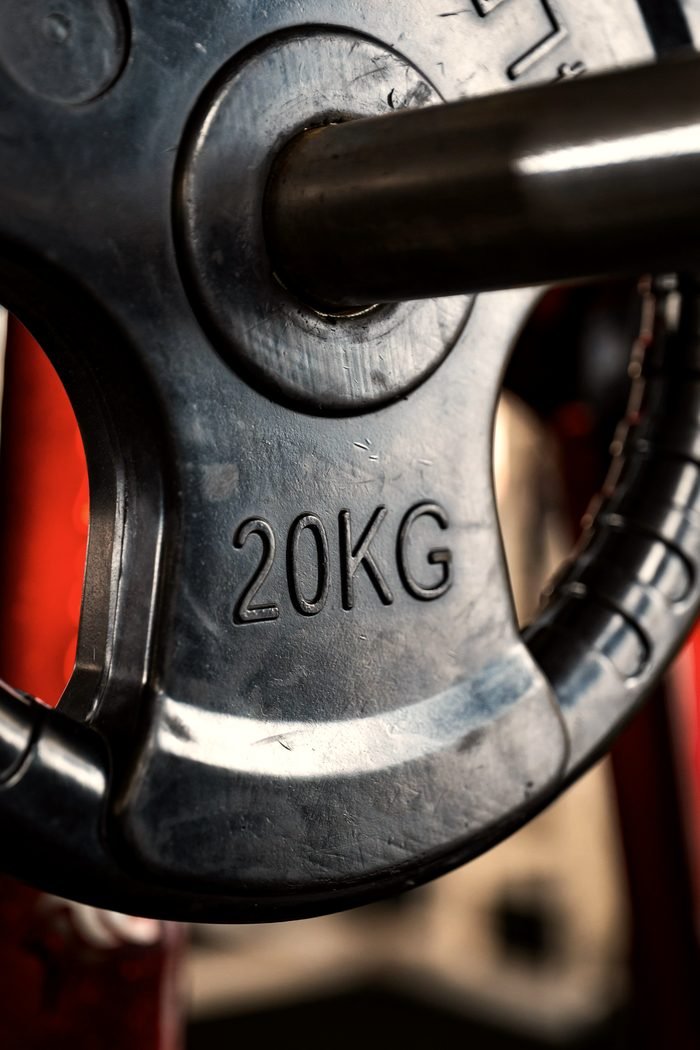
The ramp depends on your goal. Before strength work it's 20% for 10, 50% for 8, 70% for 5, 85% for 3 and 95% for 1. Warm-up weights round to 5 kg or 10 lb steps and never go below 10 kg. For each warm-up set you'll see the plates per side on a 20 kg or 45 lb bar.
Read next
 6 min readBBB vs FSL: which 5/3/1 supplemental template to runBBB is 5x10 at 50–60% of your working max and builds size. FSL is 5x5 at your first-set weight and builds strength. Here's how to choose.
 7 min readGZCLP failure protocol: what to do when you miss repsMissed reps on GZCLP? Keep the weight and drop a stage. T1 goes 5x3+, 6x2+, 10x1+ and T2 goes 3x10, 3x8, 3x6. Here's how each reset works.
Then train off that max, no calculator needed
In Strenos the same 1RM calculator is one tap away from your workout. Pick a formula and the warm-up drops straight into the session. After the workout, any heavy set you logged can become a new record.
- Warm-up into your workout in one tap
- Records saved with a caption and the video
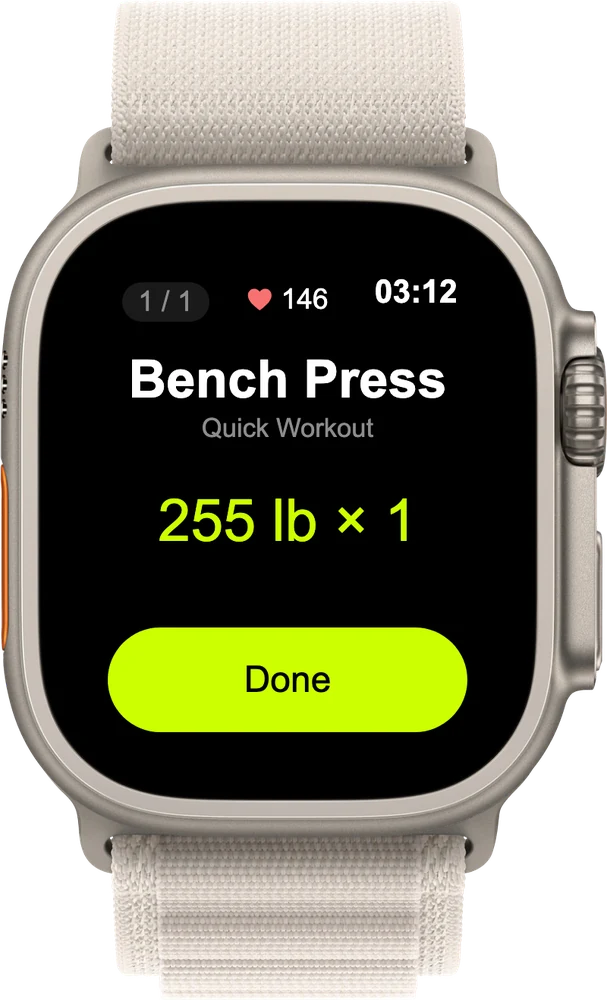
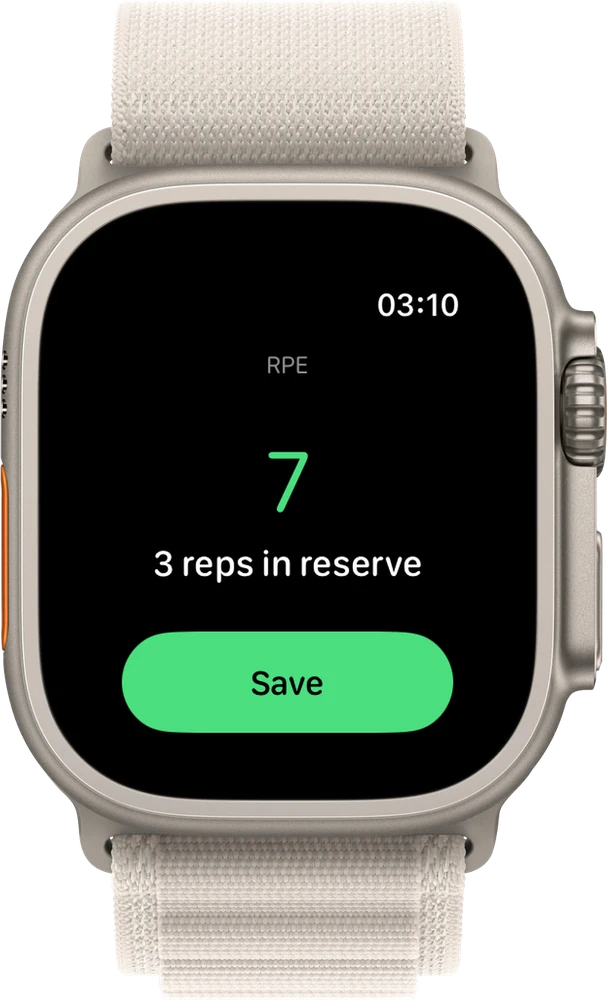
- Rate every set's RPE right on your wrist
Free on the App Store, in kg or lb.

On a computer? Point your iPhone camera at the code to open Strenos in the App Store.
Common questions
Which formula is the most accurate?
None of them fits everyone. Between 2 and 10 reps they land within a few kilos of each other, and the average evens out the differences. If the set wasn't to failure, add its RPE so the reps you had left get counted too.
Can I use a set that wasn't to failure?
Yes. Pick its RPE, and the calculator adds an estimate from the RTS table. Without an RPE, it assumes you went close to failure.
Why does it stop at 12 reps?
Past 12 reps, a set says more about your endurance than your max. So the calculator stops there, just like the app.
Does it work in pounds?
Yes. Switch to lb and pick your smallest plate. The warm-up then starts from a 45 lb bar.
What about weighted pull-ups and dips?
Use the weighted pull-up and dip calculator. It counts your bodyweight as part of the load, so the percentages on the belt come out the way the program means them.

Your next set is already worked out.
Strenos runs five programs on iPhone and Apple Watch. You log sets on your wrist, and the weights are ready before you chalk up.
Free on the App Store.