 strenos
Belt percentages that finally feel right.
Enter your bodyweight, the weight on the belt and your reps. You'll get your belt max, every rep max from 1 to 10, a warm-up and percentages of your full load, so 85% feels like 85%.
- free, same formula as the Strenos app
- kg or lb, one plate at a time
- pull-ups and dips

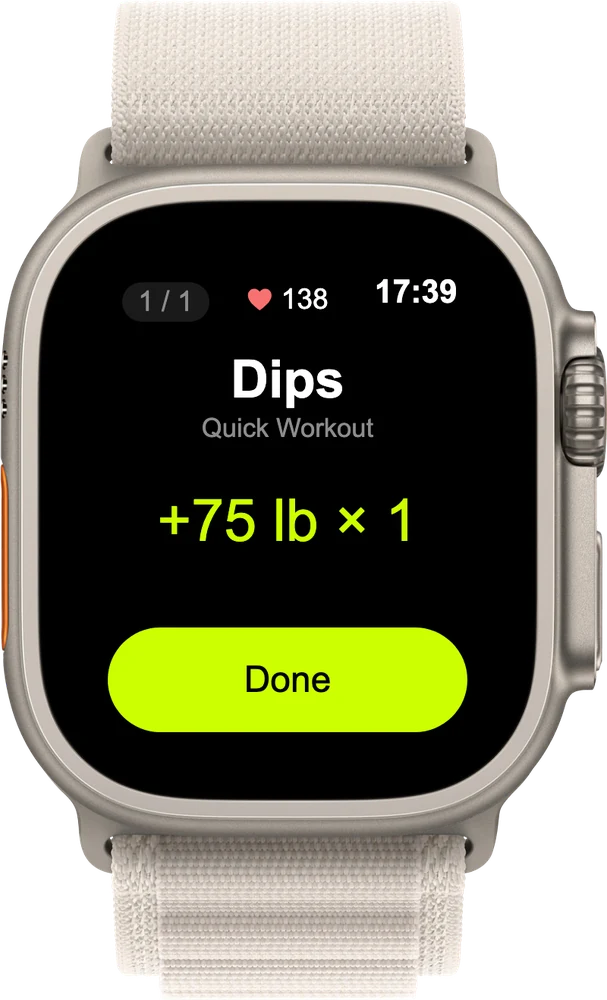
Your belt numbers, counted properly
Every percentage, warm-up step and rep max is worked out from your full load, bodyweight included.
Why the belt needs its own math
To find your weighted pull-up or dip max, count yourself in. Add your bodyweight to the belt weight, estimate the max on that total, then subtract your bodyweight. That's how streetlifters count. Percentages work from the whole load too, so a set at 85% feels like 85% on a barbell, not like a max attempt. Take them from the plate alone and every set comes out heavier than planned.
A good fit if
- You do weighted pull-ups or dips and want your working weights from percentages.
- Your 85% days feel like max attempts.
- You want to know your max without grinding out a heavy single.
- You run 5/3/1, nSuns or GZCLP with a dip belt.
Use something else if
- It's a barbell lift. The 1RM calculator is built for that.
- Your best set went past 12 reps. Estimates get shaky that high.
- You have a meet coming up. On the platform, you want weights you've actually lifted.
What to expect
- Belt weights look lighter than you're used to. Your bodyweight carries part of the load, so the effort still matches the percentage.
- Sets of five at 85% become real fives. You finish them with reps to spare, the way the program intends.
- Progress comes one plate at a time. A belt doesn't need the 5 kg jumps you make on a barbell, so small gains don't get skipped.
- Your bodyweight moves the numbers. Gain or lose a few kilos and your belt weights change too. Update it before each new cycle.
How to get it right
- Weigh yourself first. Use today's bodyweight. A few kilos change every number on the belt.
- Use a hard set of 1 to 8 reps. Short, hard sets give the cleanest estimate. The longer the set, the further the estimate drifts.
- Keep every rep strict. Dead hang to chin over the bar on pull-ups, shoulders below elbows on dips. Half reps inflate your max.
- Pick the lift. Grip gives out sooner on pull-ups, so their warm-up and work sets use fewer reps.
- Set your smallest plate. The belt takes one plate at a time, so 1.25 kg plates mean smaller jumps.
- Re-check after every cycle. Enter a fresh hard set and every percentage updates with it.

How the calculator works
It estimates your max on the full load, you plus the belt, then subtracts your bodyweight. The main formula is the streetlifting one: full load × (30 + 2 × reps) ÷ (30 + reps × a bodyweight correction). The further you are from 80 kg, the bigger the correction. The number you see is 70% this formula and 30% the classic ones, exactly as in the app.
Percentages on the belt
First, the calculator turns a percentage into reps. 85% means about five reps to failure, same as on a barbell. Then it finds the belt weight you could do exactly that many reps with and rounds it in single-plate steps. That's why 85% on the belt comes out lighter than 85% of your belt max, and still feels exactly as hard as it should.
Warm-up
It starts with a bodyweight set: 10 to 12 reps on dips and 8 to 10 on pull-ups, or fewer if you weigh 90 kg or more. Then it climbs through percentages of your belt max in 5 kg or 10 lb steps. Pull-ups never get more reps than dips.
Read next
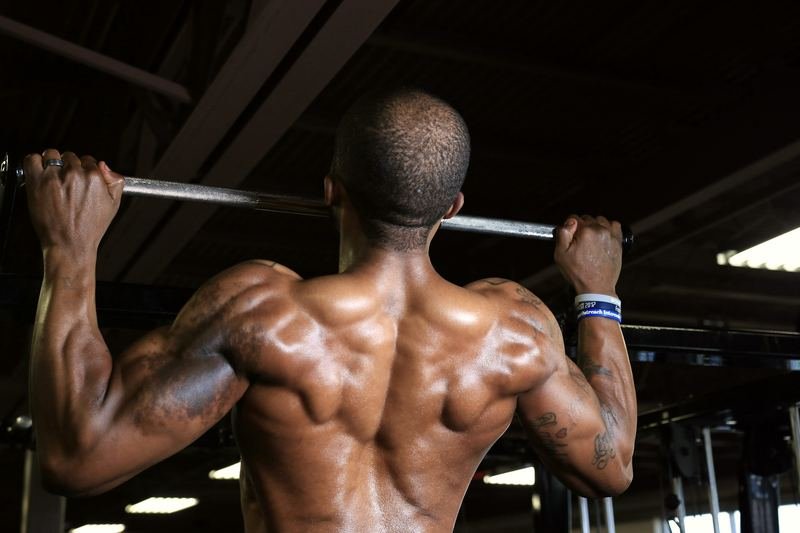 7 min readWeighted pull-up percentages: how to count your bodyweight85% of your belt weight on a pull-up is closer to 95% of your real max. Here's how to work out weighted pull-up and dip percentages with your bodyweight counted.
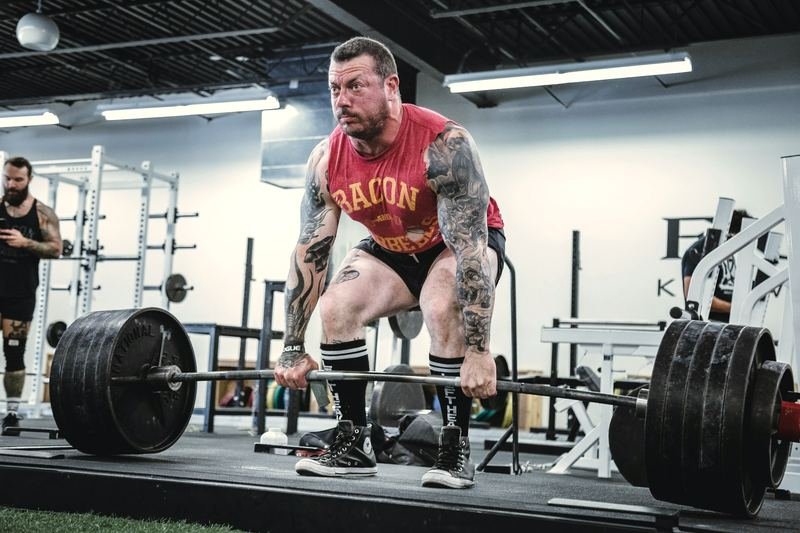 6 min readnSuns 4-day vs 5-day: which one to runThe 5-day nSuns adds an overhead press day with its own 1+ set, plus 25% more sets. Start with the 4-day unless your press is lagging and you recover well.

Then let the app do the belt math
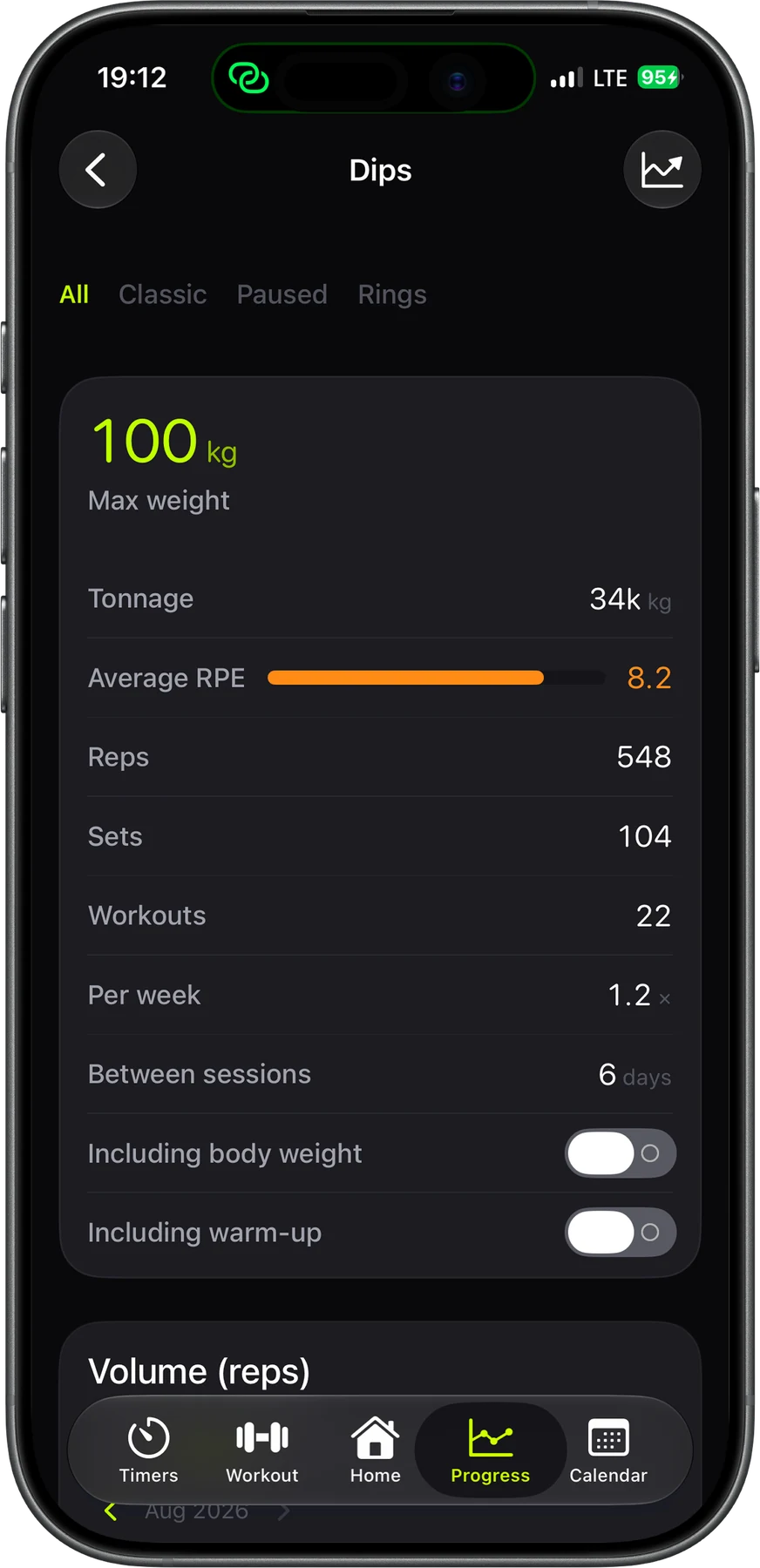
Strenos runs 5/3/1, nSuns, GZCLP and the Texas Method on weighted pull-ups and dips. It works out percentages the same way, with your bodyweight counted, and the belt goes up one plate at a time.
- Percentages that count your bodyweight
- The belt goes up one plate at a time
- Stats with or without your bodyweight
Free on the App Store. Week one of every program is free.

On a computer? Point your iPhone camera at the code to open Strenos in the App Store.
Common questions
Why is my 85% lighter than 85% of my belt max?
Because you're lifting your bodyweight too. Take 85% of the plate alone and you're close to your limit. The calculator picks the belt weight that leaves as many reps in the tank as 85% does on a barbell.
Is it the same formula as the Strenos app?
Yes. Same streetlifting formula, same blend and same rounding, all checked against the app's code.
Do pull-ups and dips count differently?
The max is estimated the same way. The warm-up and work sets differ: pull-ups get fewer reps because your grip goes first.
Kilos or pounds?
Both. Switch units, pick your smallest plate, and every belt weight rounds to something you can actually hang.
Can I plan a whole program from this?
Yes. The 5/3/1 calculator handles the belt with the same math, and the Strenos app runs 5/3/1, nSuns, GZCLP and the Texas Method on pull-ups and dips.

Your next set is already worked out.
Strenos runs five programs on iPhone and Apple Watch. You log sets on your wrist, and the weights are ready before you chalk up.
Free on the App Store.