 strenos
nSuns without the spreadsheet or the math.
Enter your max and get the day: nine sets with plates per side, plus next week's working max for any number of reps on the 1+ set. Same math as the Strenos app.
- free, same math as the Strenos app
- next working max for any rep count
- kg or lb, plates per side
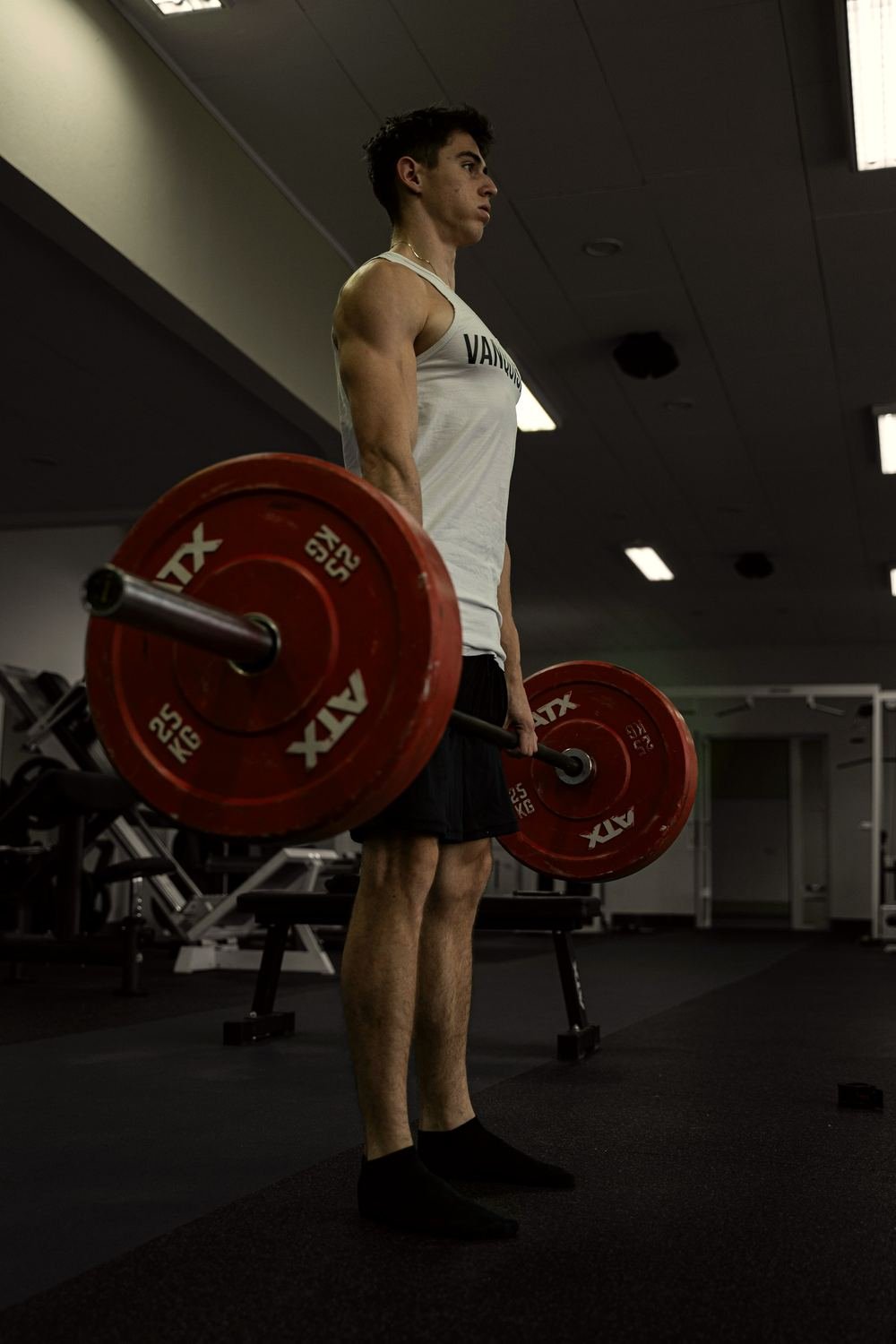
Your nSuns week
Nine sets a day with every weight and plate worked out. Enter your 1+ set reps to see next week's working max.
Is nSuns for you?
nSuns takes 5/3/1 and piles on volume. Your working max can go up every week, and one set decides where it goes next: the 1+ set at 95%, where you do as many reps as you can. It's a lot of work, and it pays off if you run it right.
A good fit if
- You've finished a beginner program and can't add weight every session anymore.
- You like long sessions and recover well. nSuns is nine heavy sets before you even get to assistance.
- You want your working max to move every week instead of once a month.
- You train three or four days a week, one main lift a day.
Pick something else if
- You've only been lifting a few months. GZCLP adds weight every session and is easier to recover from.
- You've only got 45 minutes to train. 5/3/1 covers the same lifts with less volume.
- You want to bring up one lift before a meet. Smolov Jr or the Texas Method is a better fit for that.
What to expect
- Sessions are long. Nine working sets of one lift, plus warm-ups and assistance. Plan on 60 to 90 minutes.
- The 1+ set is the whole game. One all-out set at 95% of your working max decides next week. The other sets are there for volume.
- Progress comes fast at first. Your working max can go up every week. That's why lifters move to nSuns when their beginner program stalls.
- The fatigue adds up. After a few months, most lifters need a lighter week or a reset. That's normal, and it doesn't mean you did anything wrong.
What a week looks like
In Strenos you pick two to four training days and give each one a main lift. A typical four-day week looks like this:
- Day 1 Bench: nine sets, 1+ at 95%
- Day 2 Squat: nine sets, 1+ at 95%
- Day 3 Overhead press: nine sets, 1+ at 95%
- Day 4 Deadlift: nine sets, 1+ at 95%
How to run it right
- Start from an honest max. Your working max is 90% of it. If your max is too high, you'll know in week one, because the 1+ set comes up short.
- Leave one clean rep in the tank. On the 1+ set, stop when the next rep would be a grinder. One sloppy extra rep pushes next week's weight too high.
- Log your 1+ reps every week. That number moves your working max. Without it, the program has nothing to go on.
- Keep assistance short. After nine heavy sets, three sets of 12 on one or two exercises is plenty.
- Take the reset when it comes. Your working max drops 10%, and you build back up stronger. Fight it and you'll just grind your way into a stall.

Where nSuns comes from
The program is named after its author, Reddit user n-Suns, who posted it in 2017 as a high-volume take on Jim Wendler's 5/3/1. It keeps the working max and the percentages, but swaps the slow monthly cycle for weekly progress and adds a lot more volume. It spread through r/Fitness and r/nSuns as a spreadsheet, and most people still run it that way.
As in 5/3/1, every weight comes from your working max, which sits below your true max. That buffer is what lets you handle all the volume and still hit the heavy set at 95%.
How a session is built
Each main lift gets nine working sets. The first three climb, and the third one is the 1+ set at 95% of your working max. The next five work back down for volume. On the last one, you do as many reps as you can.
| Set | % of working max | Reps |
|---|---|---|
| 1 | 75% | 5 |
| 2 | 85% | 3 |
| 3 | 95% | 1+ |
| 4 | 90% | 3 |
| 5 | 85% | 3 |
| 6 | 80% | 3 |
| 7 | 75% | 5 |
| 8 | 70% | 5 |
| 9 | 65% | 5+ |
The original spreadsheet tweaks these sets a little from day to day and adds a second lift, the T2, with eight more sets. Strenos uses this one ladder for every main lift and leaves the rest of the session to your assistance work.
How the working max moves
This is what sets nSuns apart. Your working max can change every week, and the 1+ set decides by how much.
The original spreadsheet goes by rep brackets. Get 0–1 reps and nothing is added, 2–3 reps adds about 5 lb, 4–5 reps adds 5–10 lb, and anything more adds 10–15 lb.
Strenos is stricter. It uses the Epley formula to work out what max your 1+ set proves, then compares that with the max your working max came from. Below 95% of it, your working max drops 10%, because the set just showed the old max was too high. Between 95% and 100%, it holds. Above 100%, your new working max becomes 90% of the max you just proved.
So on a fresh working max, a couple of reps on the 1+ set roll it back instead of adding weight. To raise it, you need quite a few more. The calculator above shows the exact rep counts for your numbers.
When you stall
On nSuns, a stall usually means your 1+ set has been stuck at the same reps for two or three weeks, or you keep getting reset. Before you switch programs, check three things: sleep, food and how much assistance you've piled on.
If the lift still won't budge, take the 10% reset and build back up. Most lifters end up with a better 1+ set than before. If one lift keeps stalling while the others go up, a three-week block for that lift, like Smolov Jr, is a common fix.
Common mistakes
Grinding out the 1+ set. Every grinder pushes next week's weight up faster than your strength is actually going up.
Tacking a full bodybuilding session on top. Nine heavy sets already make for a long day.
Copying the spreadsheet by hand. One wrong cell and you're training 15 lb too heavy for weeks. Let the calculator or the app do the math.
Skipping warm-up sets. Three warm-up sets before your first working set take five minutes and keep the 1+ set honest.
nSuns, 5/3/1 or GZCLP?
5/3/1 moves once a month. It's for lifters who want slow, steady progress and short sessions. nSuns moves every week and asks for far more volume. GZCLP adds weight every session and has a clear plan for missed reps, which makes it the easier next step after a beginner program.
Can't decide between four days and five? Read nSuns 4-day vs 5-day.
Read next
 6 min readnSuns 4-day vs 5-day: which one to runThe 5-day nSuns adds an overhead press day with its own 1+ set, plus 25% more sets. Start with the 4-day unless your press is lagging and you recover well.
 6 min readBBB vs FSL: which 5/3/1 supplemental template to runBBB is 5x10 at 50–60% of your working max and builds size. FSL is 5x5 at your first-set weight and builds strength. Here's how to choose.
Then let the app run nSuns
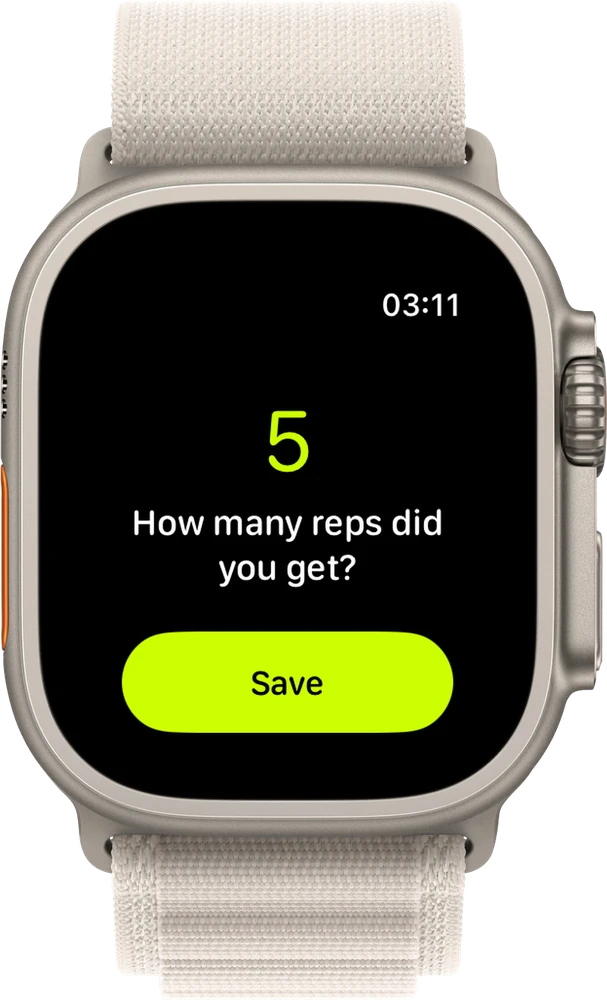
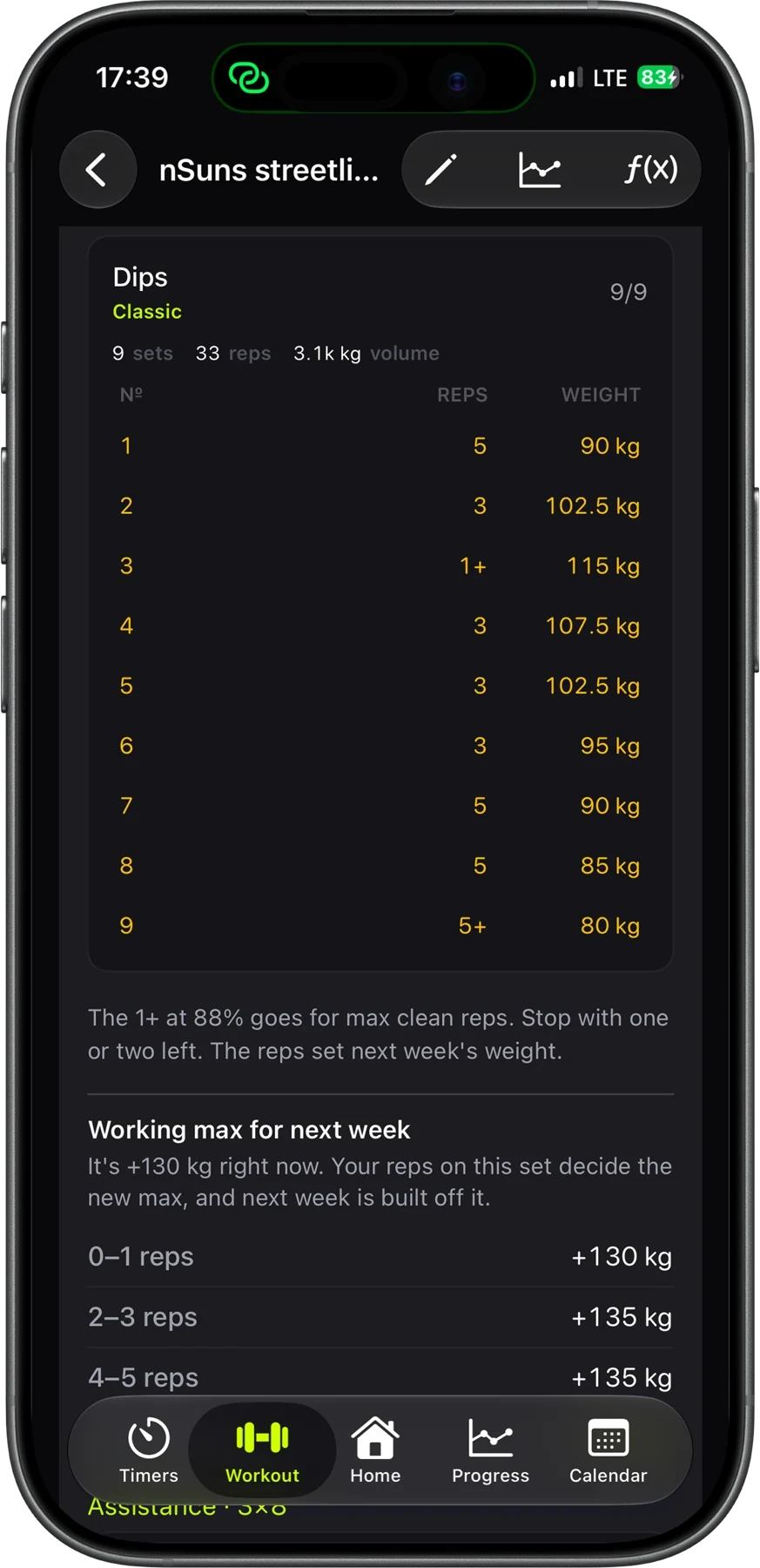
Strenos runs nSuns two to four days a week. Every session shows up with its nine sets and the plates to load. You enter your plus-set reps on the watch, and Strenos updates next week's working max for you. It works for weighted pull-ups and dips too.
- Dial in plus-set reps with the Digital Crown
- See next week's working max for any rep count
- A chart of what every plus set proved
Free on the App Store. Week one of nSuns is free.

On a computer? Point your iPhone camera at the code to open Strenos in the App Store.
Questions about nSuns
What working max does nSuns use?
90% of your 1RM, rounded to the plates your gym has. Every percentage in the session comes from that number.
How many reps should I get on the 1+ set?
On a fresh working max, four clean reps or more usually hold it, and a few more raise it. The calculator shows exactly how many reps roll it back, hold it or raise it for your numbers.
Why does Strenos drop my working max after 2 reps?
Because 2 reps at 95% of your working max prove a lower max than the one you entered. Strenos fixes that right away instead of adding weight to a number that's already too high.
Does Strenos run the T2 lifts?
No. Each day, Strenos runs the nine sets of the main lift. You add your own assistance, three sets of 12 by default.
Can I run nSuns on weighted pull-ups and dips?
Yes. The percentages include your bodyweight, and the belt goes up one plate at a time.
How many days a week?
Two to four in Strenos, with one main lift a day.
Is it free?
The first week of nSuns is free in Strenos. Full cycles, your whole history and every chart come with Plus, which you can get monthly, yearly or as a one-time Lifetime purchase.
Is this the official nSuns spreadsheet?
No. Strenos isn't affiliated with the program's author. It runs the published structure, and the differences are spelled out above.


Your next set is already worked out.
Strenos runs five programs on iPhone and Apple Watch. You log sets on your wrist, and the weights are ready before you chalk up.
Free on the App Store.