 strenos
85% of the plate, or 85% of you?
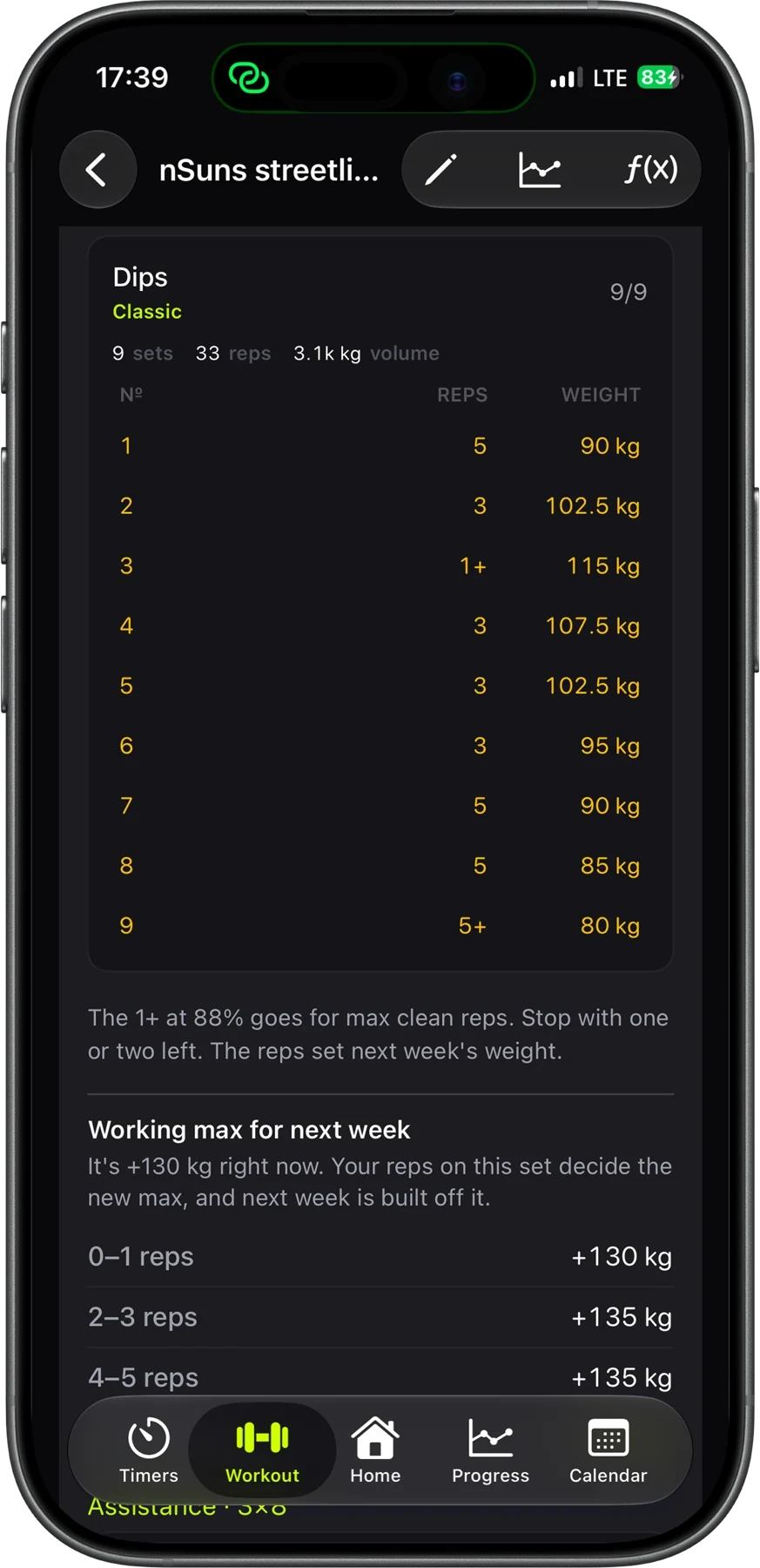
On a weighted pull-up you lift yourself plus the plate. Take 85% of the plate alone and you're really at about 95% of your max, so your sets of five turn into grinders and your belt weight stalls. Strenos works from the whole load and adds one small plate at a time.
No ads. No paywall mid-set. Nothing you log is ever deleted.

 On a computer? Scan with your iPhone
The program says 85%. What goes on the belt?
It looks simple: take 85% of your best. Do that and you'll hang 9 kg too much on the belt and get 1 or 2 reps instead of 5. Let's run the numbers on one athlete.
-
01
What you're really lifting
80 kgyour bodyweight+40 kgyour best on the belt=120 kgwhat you lift at your maxOn the bar, you pull up yourself and the plate. So your real max is 120 kg, even though only 40 of it hangs on the belt.
-
02
What 85% means in a program
about 5 reps85% is a weight you can lift about 5 times in a row. That's how it works on a barbell, and percentage programs are built around it.
-
03
Two ways to do the math
The usual way85% of 40 kg = 34 kg
+34 kgon the belt
With your bodyweight, that's 114 kg, or 95% of your max.
You get 1 or 2 repsThat's close to your limit. Instead of a working set, you get a max attempt.
StrenosFinds the weight you can lift 5 times
+25 kgon the belt
With your bodyweight, that's 105 kg.
You get about 5 repsExactly what the program's author had in mind.
The takeaway: on the belt, you can't take a percentage of the plate alone. Strenos turns the percentage into reps, the way it works on a barbell, then finds the belt weight for those reps and rounds it to the smallest plate in your gym.
Run my numbersWhy barbell apps get the belt wrong
| Topic | A barbell app | StrenosOn iPhone and Apple Watch |
|---|---|---|
| Percentages | Taken from the plate alone, so 85% lands close to your max | Taken from you plus the plate, then turned back into a belt weight |
| Weight steps | Jumps of 5 kg, two plates at a time | One small plate at a time. Half the jump, so you keep moving up longer |
| 1RM estimate | Worked out from the belt weight alone | A streetlifting formula that includes your bodyweight |
| Your bodyweight | Left out of the math | Pulled from your weight in the app. Change it and the numbers follow |
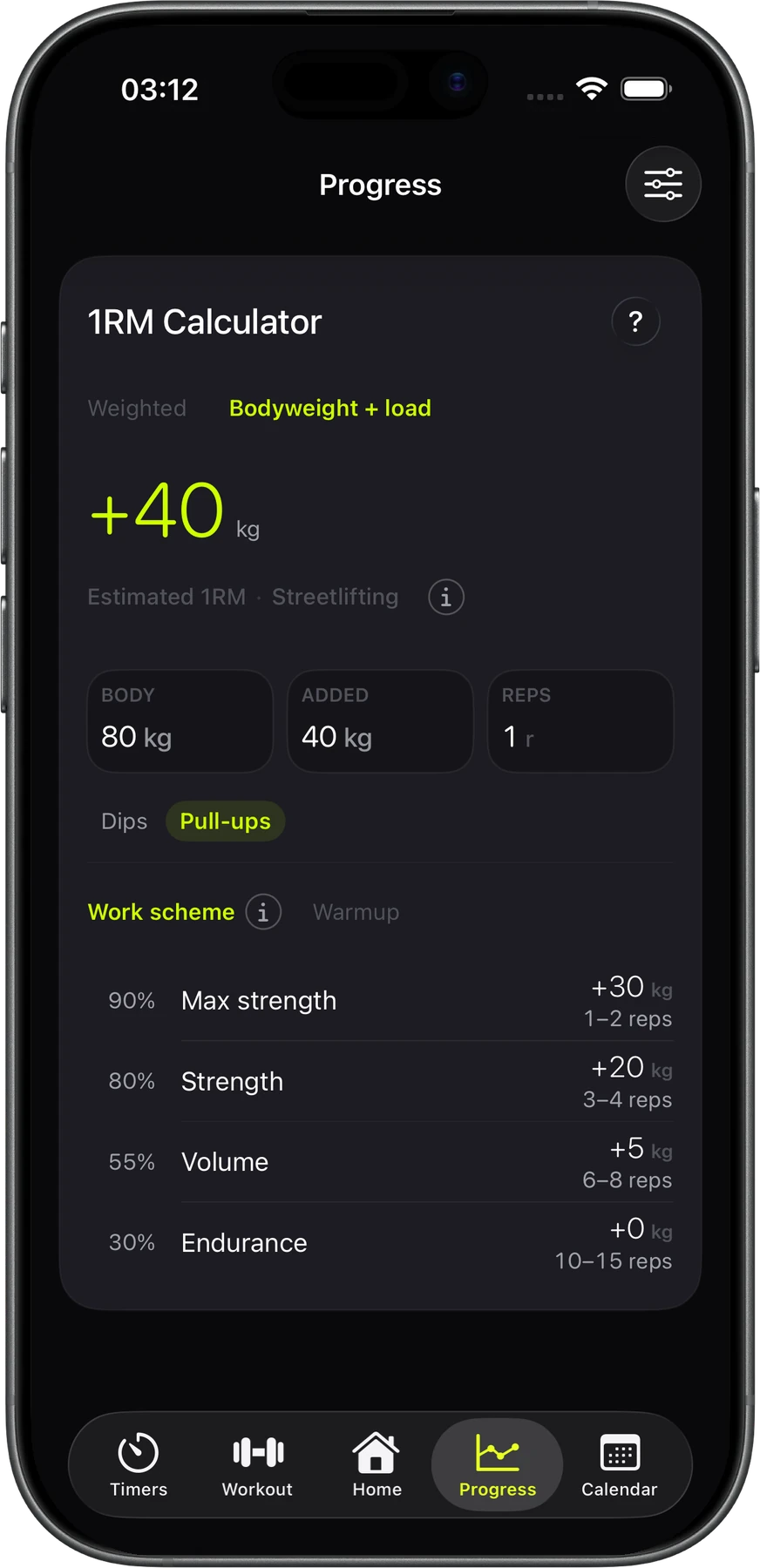
Know your max without a test day
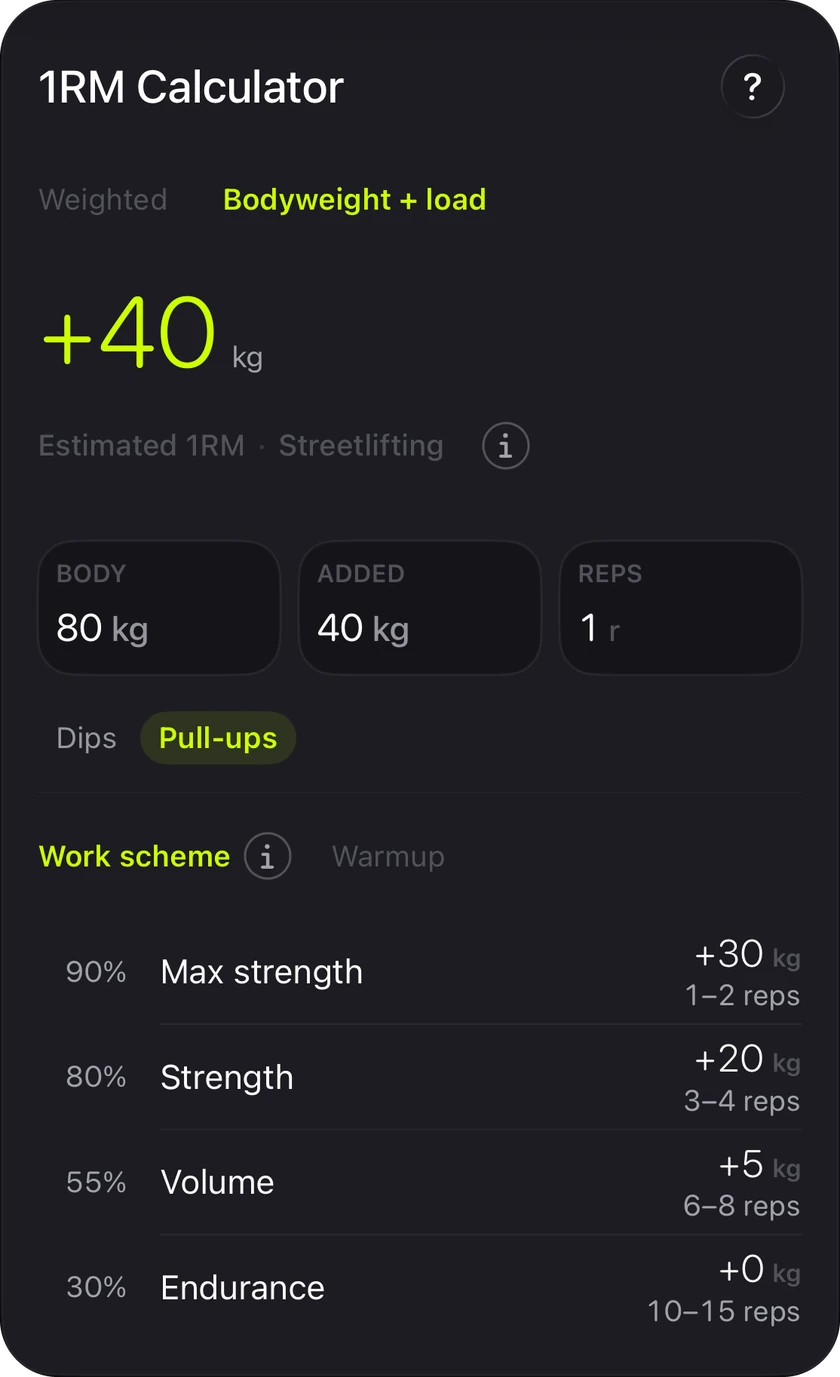
Enter your bodyweight, the weight on the belt and the reps you got. The calculator estimates your max with a streetlifting formula and gives you a belt weight for every zone, from max strength to endurance. You can send the warm-up straight into your workout.
Find my maxEvery kilo on the belt goes on the record
Stats and records built for the belt, so +60 means +60.
-
01 / 02
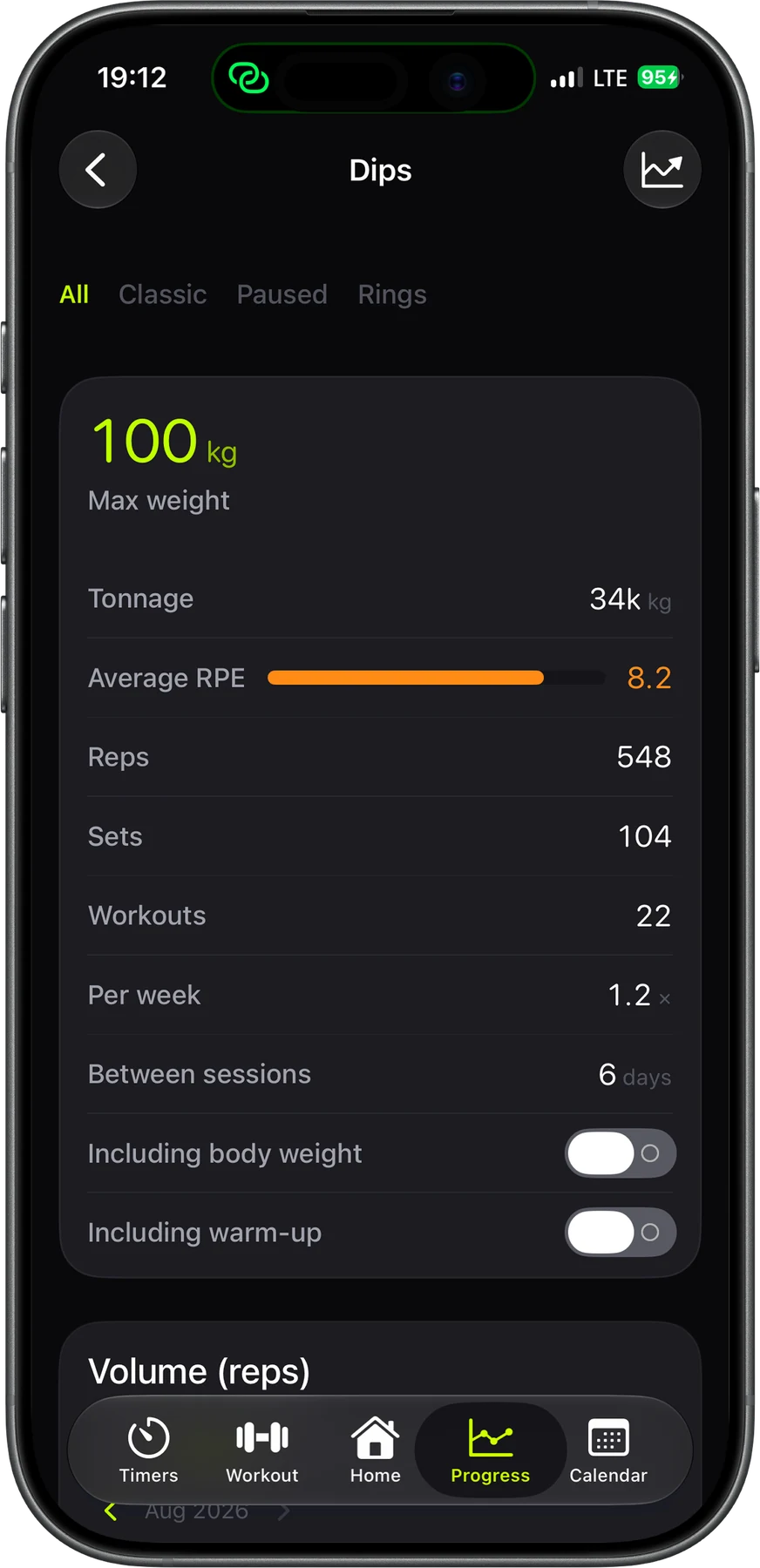
Totals with or without your bodyweight
Track max weight, tonnage, average RPE, reps and sets for dips and pull-ups. One toggle adds your bodyweight to the totals or takes it back out.
-
02 / 02
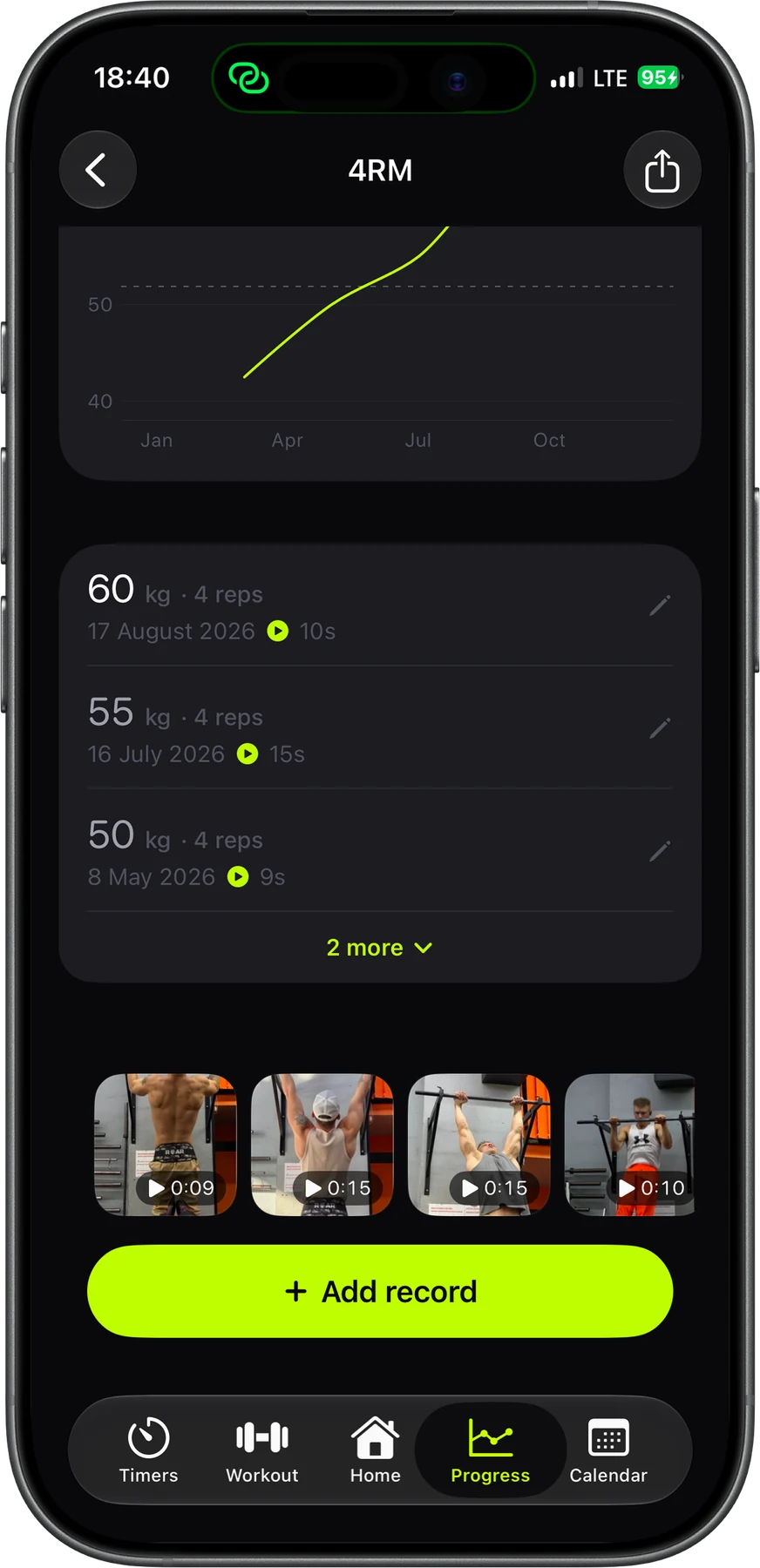
Every record on video, so the rep speaks for itself
Log rep maxes at any rep count, max reps at a given weight and timed holds. Each record has its own history chart and videos of your attempts, synced through your own iCloud.
 Free calculator
Run 5/3/1 on pull-ups and dips, no spreadsheet needed.
Switch the calculator to pull-ups or dips, enter your bodyweight and your best single, and get all four weeks with a belt weight for every set. Plan my belt cycle
Questions about streetlifting
Why are my numbers lower than in the original program?
Because the original percentages were written for a barbell. On the belt, the same effort comes at a lighter added weight, and that's the weight Strenos gives you.
Why +25 kg and not +22?
Take 85% of the full 120 kg, subtract your 80 kg, and you get +22. But pull-ups have their own curve: five clean reps come at about 87.5% of the full load, not 85%. Strenos matches the reps a percentage stands for on a barbell, so it gives you +25.
Where does my bodyweight come from?
From the weight you log in the app. Log a new one on the home screen and the next numbers use it.
Which programs run on the belt?
5/3/1, nSuns, GZCLP and the Texas Method. Smolov Jr is barbell only.
What's free, and what's Plus?
Free for good: logging pull-ups and dips with any weight, the Apple Watch app, records from your sets, the readiness score and the 1RM calculator. The first week of every program is free too, so you can feel how it runs on your own numbers. Full cycles, your whole history and every chart come with Plus: monthly, yearly or a one-time Lifetime purchase.
Does it work in pounds?
Yes. The belt goes up by the smallest plate in your gym, in kilos or pounds.
Read before you load the belt
All guides 7 min readWeighted pull-up percentages: how to count your bodyweight85% of your belt weight on a pull-up is closer to 95% of your real max. Here's how to work out weighted pull-up and dip percentages with your bodyweight counted.
 6 min readBBB vs FSL: which 5/3/1 supplemental template to runBBB is 5x10 at 50–60% of your working max and builds size. FSL is 5x5 at your first-set weight and builds strength. Here's how to choose.
 6 min readnSuns 4-day vs 5-day: which one to runThe 5-day nSuns adds an overhead press day with its own 1+ set, plus 25% more sets. Start with the 4-day unless your press is lagging and you recover well.

Your next set is already worked out.
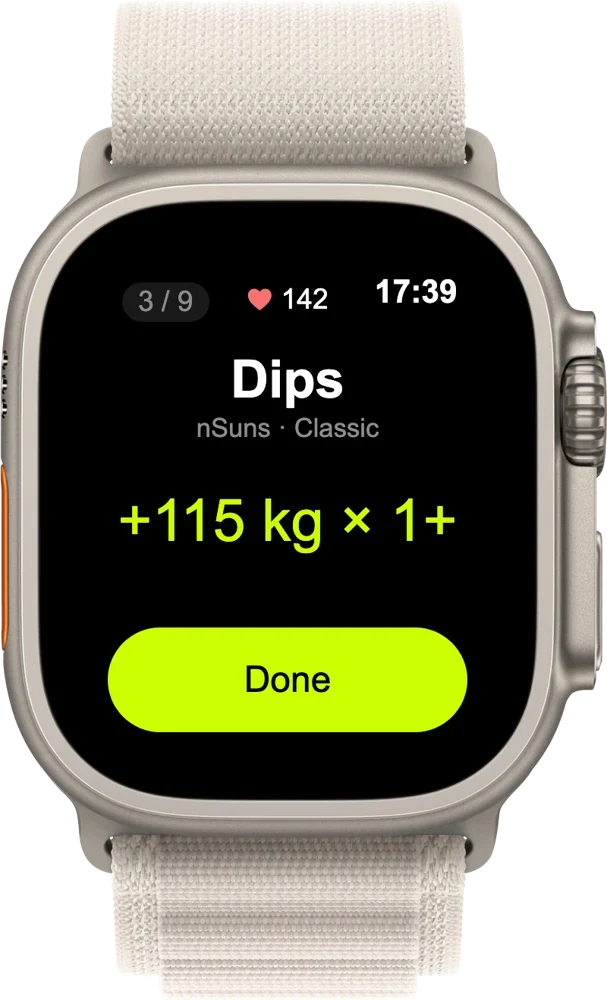
Strenos runs five programs on iPhone and Apple Watch. You log sets on your wrist, and the weights are ready before you chalk up.
Free on the App Store.