 strenos
Your full 5/3/1 cycle, down to the last plate.
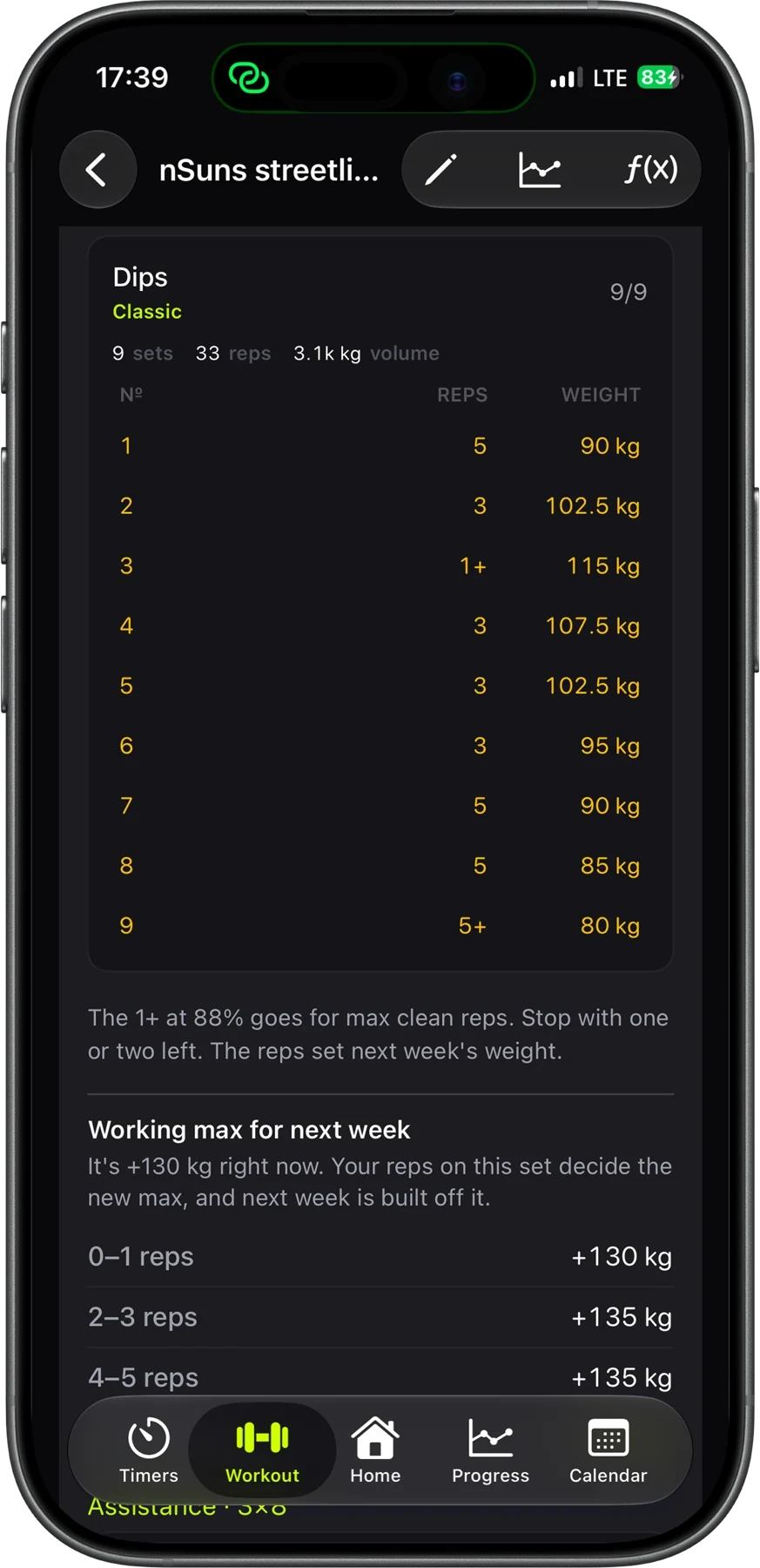
Enter your 1RM and get all four weeks: warm-ups, working sets, plus sets and plates per side. It works for the barbell and for weighted pull-ups and dips.
- free, same math as the Strenos app
- kg or lb, rounded to your gym's plates
- works for weighted pull-ups and dips too

Your four weeks
Change anything and every set updates: warm-ups, working sets, assistance and plates.
Is 5/3/1 right for you?
5/3/1 is Jim Wendler's strength program built around the squat, bench press, deadlift and overhead press. Each lift runs a four-week cycle: a week of fives, a week of threes, a 5/3/1 week and a deload. Every percentage comes from your working max, 90% of your 1RM. In the first three weeks the last set is a plus set, where you do as many reps as you can. Lifters stay on it for years. Here's who it suits, what to expect and how to run it right.
A good fit if
- You've been lifting for at least six months, and adding weight every session has stopped working.
- You'd rather gain slowly for years than peak fast.
- You can train three or four days a week.
- You want a bigger squat, press and deadlift, or more weight on your belt for pull-ups and dips.
Pick something else if
- You're only a few months into lifting. For now, a simple program that adds weight every session will get you stronger faster.
- You have a meet within the next eight weeks. Run a peaking block instead.
- You want to lift as heavy as you can this month. 5/3/1 starts light on purpose.
What to expect
- The first cycle feels easy. Your working max is 90% of your 1RM, so the weights look light. That's on purpose: it leaves room for rep PRs on your plus sets.
- Progress shows up in reps first. If you get more reps on a plus set with the same weight, you got stronger, even though the bar didn't get heavier.
- The working max climbs in small steps. Classic 5/3/1 adds 5 lb to the presses and 10 lb to the squat and deadlift each cycle. Strenos moves it based on how many reps you get on your week 3 plus set.
- Expect a reset now and then. When a plus set falls short of the plan, the working max drops 10% and you build back up. Everyone who lifts long enough goes through it.
A classic 4-day week
You do one main lift a day, then your assistance. On three days a week, keep the same order and let the lifts rotate.
- Day 1 Overhead press
- Day 2 Deadlift
- Day 3 Bench press
- Day 4 Squat
How to run it right
- Start light. Use a true 1RM or a recent heavy single. If you're not sure, enter a lower number. Starting too heavy is the fastest way to stall.
- Do every warm-up set. They're light for a reason. They groove the lift and get you ready for the top set.
- Make the plus set count. Get every clean rep you can, and stop a rep or two before your form breaks down. Ugly grinders don't count.
- Take the deload. Week 4 is light on purpose. Skip it, and the next cycle usually goes sideways.
- Keep assistance simple. Do BBB or FSL after the main lift, then some pulling, single-leg and core work. More isn't better if it eats into your main lifts.
- Log every plus set. Rep PRs are your real progress, and Strenos uses them to set your next working max.

How the calculator works
Everything runs off your working max (Wendler calls it the training max). He sets it at 90% of your 1RM, and every working set in the cycle is a percentage of that number instead of your true max.
| Week | Set 1 | Set 2 | Set 3 |
|---|---|---|---|
| Week 1 | 65% × 5 | 75% × 5 | 85% × 5+ |
| Week 2 | 70% × 3 | 80% × 3 | 90% × 3+ |
| Week 3 | 75% × 5 | 85% × 3 | 95% × 1+ |
| Week 4, deload | 40% × 5 | 50% × 5 | 60% × 5 |
In weeks 1 to 3 the last set is the plus set: as many good reps as you've got, stopping before your form breaks down. Week 4 is a deload, so there's no plus set.
The warm-up
The warm-up is based on your true 1RM instead of the working max: the empty bar for 5, then 40% for 5 and 60% for 3. If a warm-up set would be as heavy as your first working set or heavier, the calculator drops it. That way the warm-up never ends up heavier than the work on a light week.
Rounded to your plates
Pick the smallest plate in your gym. You load the bar in pairs, so with 2.5 kg plates every weight moves in 5 kg steps, and with 1.25 kg plates in 2.5 kg steps. Pounds work the same way: 5 lb plates give you 10 lb steps, and 2.5 lb plates give you 5 lb steps. Every weight rounds to the nearest step you can actually load.
Under each week you'll see the plates per side for the top set.
Weighted pull-ups and dips
Switch the lift to a weighted pull-up or dip and enter your bodyweight. On these lifts you move your own body as well as the belt, so a straight percentage of the belt weight comes out far heavier than planned. 85% of the plates can be about 95% of what you actually lift. The calculator picks each belt weight so the set is as hard as the same percentage on a barbell. The full math is in our guide to weighted pull-up percentages.
BBB and FSL
Assistance adds volume after the main sets. Boring But Big (BBB) is 5 sets of 10 at 50, 60 or 70% of your working max. First Set Last (FSL) takes the week's first working weight and repeats it for 5 sets of 5. You skip both on the deload week. Can't decide between them? Read BBB or FSL: which assistance to run.
Read next
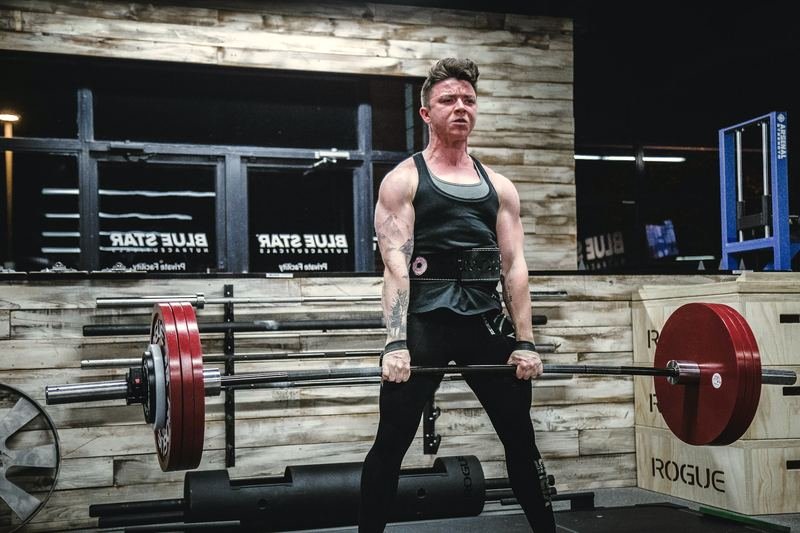 6 min readBBB vs FSL: which 5/3/1 supplemental template to runBBB is 5x10 at 50–60% of your working max and builds size. FSL is 5x5 at your first-set weight and builds strength. Here's how to choose.
 7 min readWeighted pull-up percentages: how to count your bodyweight85% of your belt weight on a pull-up is closer to 95% of your real max. Here's how to work out weighted pull-up and dip percentages with your bodyweight counted.

Then let the app run the cycle
Strenos lays the cycle out session by session. You get the right weights on the right day and a rest timer between sets, and your plus sets move your working max.
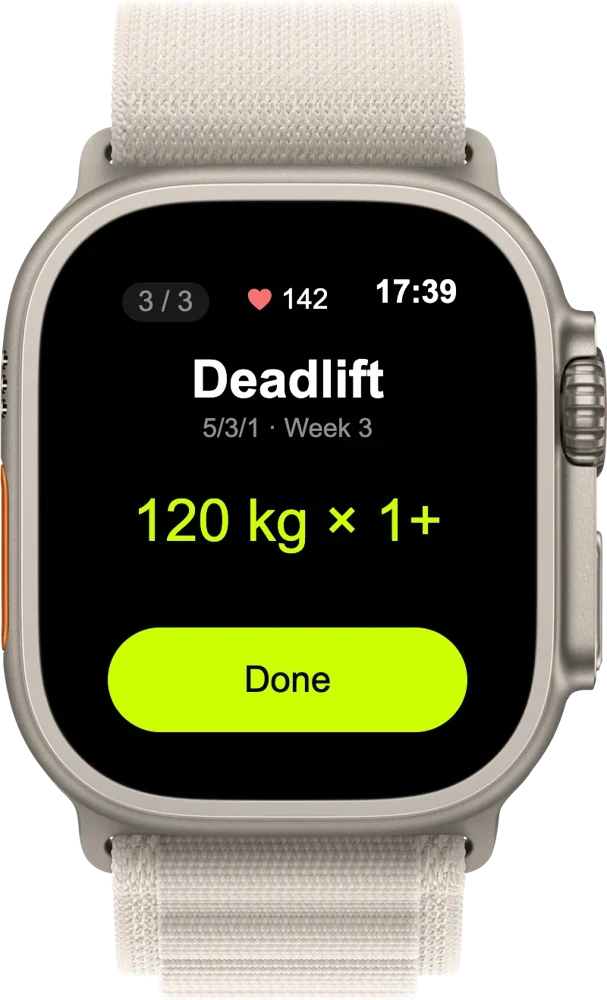
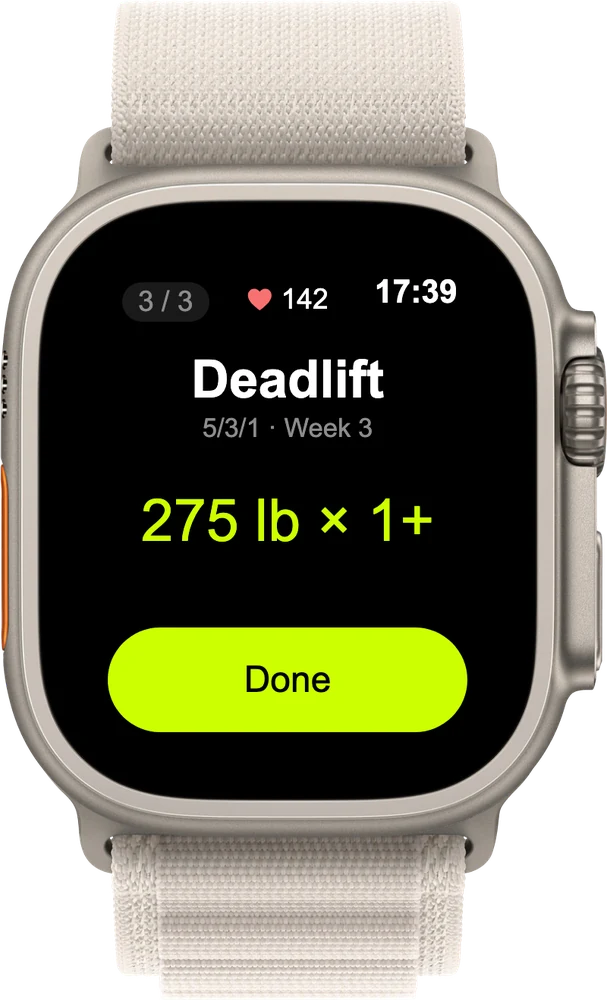
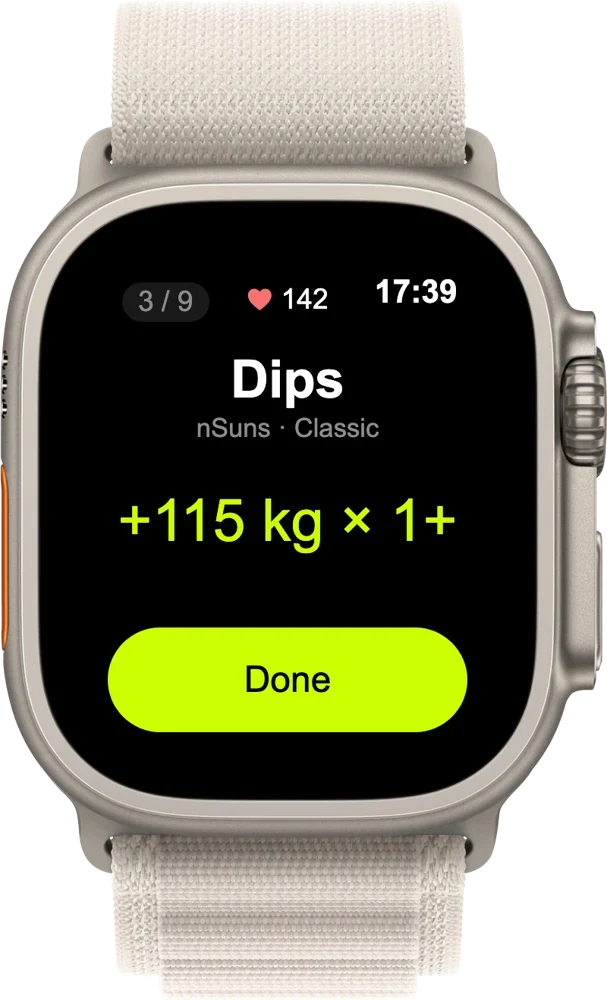
- Log every set on your Apple Watch
- Plus sets decide your next weights
- Weights rounded to your gym's plates
Free on the App Store. Full cycles come with Strenos Plus.

On a computer? Point your iPhone camera at the code to open Strenos in the App Store.
Common questions
What is the working max in 5/3/1?
It's 90% of your 1RM, and every percentage in the program is based on it. Starting a little light is the point. It leaves room to beat your plus sets and keeps you progressing for months.
Should my working max be 85% or 90%?
Wendler's original program uses 90%. In his later books he often starts lower, around 85%, especially for lifters coming back to the program. This calculator and the app use 90%. Want 85%? Enter a 1RM about 5% lower.
How does the working max go up?
Classic 5/3/1 adds 5 lb to the presses and 10 lb to the squat and deadlift after each cycle. Strenos goes by what you actually lift instead. If a plus set shows a higher max than your working max is based on, the new working max is 90% of that higher max. If a plus set comes in more than 5% short of plan, the working max drops 10%.
Why are my numbers different from other 5/3/1 calculators?
There are two reasons. Most calculators round to a fixed 5 lb or 2.5 kg, while this one rounds to your gym's plates. And on weighted pull-ups and dips, most of them take a straight percentage of the belt weight, which makes every set heavier than the program intends.
Does it work in pounds?
Yes. Switch the units to lb and pick your smallest plate. The warm-up then starts with a 45 lb bar.


Your next set is already worked out.
Strenos runs five programs on iPhone and Apple Watch. You log sets on your wrist, and the weights are ready before you chalk up.
Free on the App Store.