 strenos
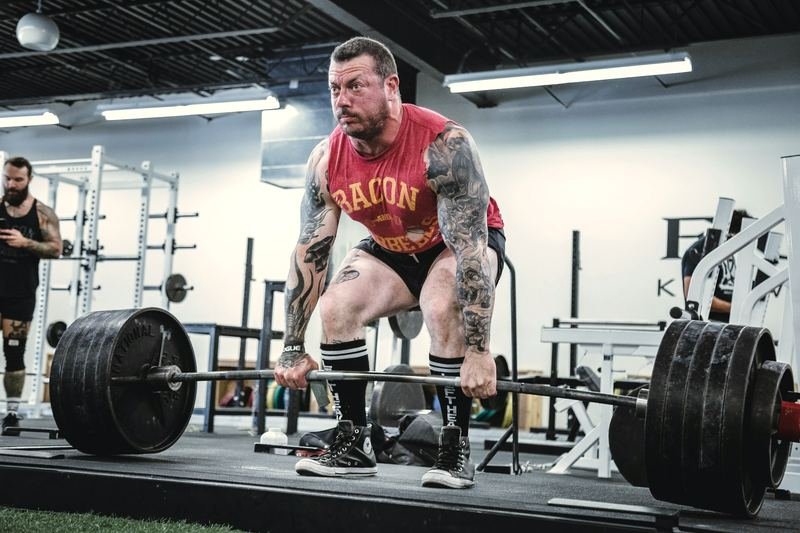
Start with the 4-day unless you have a good reason not to. Squat, bench and deadlift each get a 1+ set, and you still have three rest days a week. The 5-day adds one more session, overhead press followed by incline bench. Move up to it when your press needs a heavy day of its own and your sleep and food can handle about 25% more sets.
The 5-day is simply the 4-day with a press day added. Everything else carries over: nine T1 sets, eight T2 sets and a working max bump every week.
The two layouts
Every nSuns session pairs two lifts. The T1 lift is the main work of the day, nine sets. The T2 lift is eight sets of a related movement. Here's the week, session by session:
| Session | 4-day | 5-day |
|---|---|---|
| 1 | Bench volume day (T1) + overhead press (T2) | Bench volume day (T1) + overhead press (T2) |
| 2 | Squat (T1) + sumo deadlift (T2) | Squat (T1) + sumo deadlift (T2) |
| 3 | Not in this template | Overhead press (T1) + incline bench (T2) |
| 4 | Deadlift (T1) + front squat (T2) | Deadlift (T1) + front squat (T2) |
| 5 | Bench 1+ day (T1) + close-grip bench (T2) | Bench 1+ day (T1) + close-grip bench (T2) |
| Working sets per week | 68 | 85 |
| Lifts with a 1+ set | Squat, bench, deadlift | Squat, bench, deadlift, press |
Spreadsheets don't all list the days in the same order. The pairs are what matter. Take session 3 out of the 5-day and you're left with the 4-day.
What a T1 day looks like
Every weight comes off your working max (TM), which nSuns sets at 90% of your 1RM. It's the same idea as the working max in Wendler's 5/3/1. A standard T1 day, squat for example, goes like this:
75% x5, 85% x3, 95% x1+, 90% x3, 85% x3, 80% x3, 75% x5, 70% x5, 65% x5+
With a 200 lb working max, that's 150x5, 170x3, 190x1+, 180x3, 170x3, 160x3, 150x5, 140x5 and 130x5+. Deadlift and the second bench day follow the same pattern, with slightly different reps on the way down.
The third set, 95% for as many reps as you can get, is the 1+ set. It decides next week's working max. The last set also goes to max reps, but it's only there for volume and doesn't change your TM.
Bench volume day has no 1+ set. You work up through 65% x8 and 75% x6, do three sets of 4 at 85%, then work back down with 80% x5, 75% x6, 70% x7 and 65% x8+. Your bench TM moves off the other bench day.
T2 lifts get eight sets that ramp up and then hold. Press tops out around 70% of its own TM, and sumo deadlift around 70% of your deadlift TM. Front squat and close-grip bench run lighter.

The short answerStart with the 4-day. Add the fifth day only if your overhead press lags and you recover well.
Progression is where they really differ
nSuns moves every working max once a week, based on how many reps you get on the 1+ set:
- 0–1 reps: no change
- 2–3 reps: +5 lb
- 4–5 reps: +5–10 lb
- 6+ reps: +10–15 lb
That rule is why the press day matters. On the 5-day, overhead press gets its own T1 day with a 1+ set, so it moves just like the big three: a good week shows up in next week's numbers. On the 4-day, press only appears as T2 work on bench volume day. It never gets a 1+ set, so spreadsheets and apps progress it like any other T2 lift. Finish all eight sets and it goes up by a small fixed amount, usually 5 lb. That's slower, and a great week counts the same as an average one.
Bench is identical in both templates, with one volume day and one 1+ day. So are squat and deadlift. If your press is moving fine on fixed bumps, the 5-day won't buy you much.
Recovery
Every nSuns day is already 17 working sets before you add a single accessory. The 5-day adds another of those days, 17 sets on top of 68, and all of them are presses. Count the pressing slots. The 4-day has four a week: bench T1 on two days, plus press and close-grip bench as T2. The 5-day has six. If your shoulders or elbows are usually the first to complain, that's where you'll feel the extra day.
Boostcamp, which has nSuns built into its app, tells lifters to run the 4-day for several weeks before moving up. That's good advice. You find out how you recover from 68 sets a week before you sign up for 85.
How to choose
Run the 4-day if:
- you're new to nSuns or coming off a novice program;
- four sessions a week is all your schedule really allows;
- squat and deadlift are your priority;
- you're eating in a deficit and recovery is already tight.
Run the 5-day if:
- you've run the 4-day for several weeks and you're still hitting your 1+ sets;
- your press has been creeping up 5 lb at a time and you want your 1+ reps to set the pace;
- you can fit five sessions into your week without losing sleep;
- you like a lot of pressing and your shoulders can take it.
The simplest way to decide is to start on the 4-day and keep an eye on two things: your 1+ reps on the big three, and your press. If your 1+ sets keep landing at 2–5 reps and press is the only lift falling behind, add the press day.
When a lift stalls on either template, the usual fix is to drop its working max by about 10% and keep going. nSuns has no scheduled deload, so that reset is your pressure valve.
How Strenos runs nSuns
Strenos builds the nine-set T1 day for two to four main lifts, each on its own day. Once a week it updates each working max from your 95% 1+ set. It doesn't build the eight-set T2 blocks. If you want a second lift that day, add it as assistance and set the weight and rep target yourself.
Strenos also handles the 1+ set differently from the rep table above. It turns the set into an estimated max and sets your new working max at 90% of what you proved, rounded to your plates. At 95%, three reps or fewer drops the TM by 10%, four or five holds it, and six or more starts moving it up. And since every lift gets its own T1 day, you get the 5-day's main advantage anyway: make overhead press one of your four lifts and it gets a 1+ set every week.