 strenos
GZCLP with every weight ready before you train.
Enter your maxes and get every GZCLP workout: T1, T2 and T3 with plates per side, the weight for each stage and what happens when you miss reps. Same math as the Strenos app.
- free, same math as the Strenos app
- T1, T2 and T3 for every workout
- what happens after a missed stage

Your GZCLP weeks
Every workout with T1, T2 and T3, the weights for your plates, and where each lift goes when you miss reps.
Is GZCLP for you?
GZCLP is Cody Lefever's beginner program built on tiers. Every workout has one heavy lift (T1), one volume lift (T2) and assistance (T3), and the weight goes up each time a lift comes around. Miss your reps and you don't start over: the lift keeps its weight and moves to the next stage.
A good fit if
- You're in your first year or two of lifting and can still add weight every workout.
- You want a clear plan for missed reps instead of guessing.
- You train three or four days a week.
- You want heavy triples and volume work in the same program.
Pick something else if
- You've already run every stage to the end more than once. 5/3/1 or nSuns moves slower but lasts longer.
- You want one lift up fast before a test. Smolov Jr is built for that.
- You can only train twice a week. Then one rotation of four workouts takes two weeks.
What to expect
- The first weeks feel easy. T1 starts at 85% of your 5-rep max. That's on purpose: the weight goes up every workout, so the climb matters more than the start.
- Rest on T1 is long. Strenos gives T1 four minutes, T2 two and a half and T3 a minute and a quarter.
- Missed reps are part of the plan. Sooner or later you'll fall short. The weight stays, the reps per set drop, and you keep going.
- Every lift shows up twice per rotation. With four lifts, each one comes up once heavy and once for volume over four workouts.
What a rotation looks like
In Strenos you pick three or four workouts a week and an even number of lifts, from two to six. With the classic four lifts, the rotation looks like this:
- A1 Squat T1, bench T2
- B1 Overhead press T1, deadlift T2
- A2 Bench T1, squat T2
- B2 Deadlift T1, overhead press T2
How to run it right
- Count total reps, not sets. A stage passes when you hit its total: 15 reps on 5×3+, 30 on 3×10. Extra reps on the last set count.
- Stop the + set on a clean rep. Go for as many reps as you can, but skip the grinders. They won't make the weight go up any faster.
- Pick T3 lifts you can do for 15. Lat pulldowns, rows, curls. Once you get 25 reps on the last set, add weight.
- Log every set. Your next workout depends on the reps you got in the last one. Without them, the program can't tell a pass from a miss.
- Don't fear the restart. After the last stage, T1 starts over at 85% of the weight you reached and climbs again.

Where GZCLP comes from
GZCLP is the beginner version of the GZCL method by Cody Lefever, a powerlifter and coach who goes by GZCL online. The method is built on tiers: heavy work for low reps first, lighter volume work next, then assistance. GZCLP turns that into a program where the weight goes up every workout. It spread on Reddit, in r/Fitness and r/gzcl, where lifters shared spreadsheets and apps for it.
The three tiers
A plus sign means the last set goes for as many reps as you can. Each stage has a total: 15, 12 and 10 reps for T1, and 30, 24 and 18 for T2.
| Tier | Stage 1 | Stage 2 | Stage 3 | Rest in Strenos |
|---|---|---|---|---|
| T1 | 5×3+ | 6×2+ | 10×1+ | 4 min |
| T2 | 3×10 | 3×8 | 3×6 | 2.5 min |
| T3 | 3×15+ | – | – | 1 min 15 s |
How the weight goes up
Pass a stage and the weight goes up the next time that lift comes around: 5 lb (2.5 kg) on upper-body lifts and 10 lb (5 kg) on lower-body lifts. Strenos rounds to the plates in your gym, so if your smallest plate is 5 lb, the bar moves in 10 lb steps.
Miss the total and the lift keeps its weight but moves to the next stage. After the last stage, T1 goes back to 5×3+ at 85% of the weight you reached. T2 goes back to 3×10 with the last weight you got 3×10 on, plus 15 lb (7.5 kg).
Where Strenos differs from the original
There's one difference. In the original, when T1 fails its last stage, you test a new 5-rep max and restart at 85% of it. Strenos skips the test and restarts at 85% of your current T1 weight. Everything else, the stages, the rep totals and the T2 restart, follows the program.
Common mistakes
Starting too heavy. The light start is the point. If week one feels easy, the program is working.
Calling a stage failed when the total is there. 3, 3, 2, 3 and 5 reps add up to 16, which clears 15. That's a pass.
Piling on T3. Two or three assistance lifts are plenty.
Training without a log. GZCLP decides every workout from the last one. Write down your reps.
GZCLP, nSuns or 5/3/1?
Of the three, GZCLP is the one for beginners: the weight goes up every workout, and missed reps have a plan. nSuns is the next step once a beginner program stops working: more volume and a working max that moves every week. 5/3/1 moves once a month and lasts for years. If percentages are new to you, start with GZCLP.
There's a separate guide on what to do when you miss reps, and all five programs side by side on the programs page.
Read next
 7 min readGZCLP failure protocol: what to do when you miss repsMissed reps on GZCLP? Keep the weight and drop a stage. T1 goes 5x3+, 6x2+, 10x1+ and T2 goes 3x10, 3x8, 3x6. Here's how each reset works.
 6 min readnSuns 4-day vs 5-day: which one to runThe 5-day nSuns adds an overhead press day with its own 1+ set, plus 25% more sets. Start with the 4-day unless your press is lagging and you recover well.
Then let the app run GZCLP
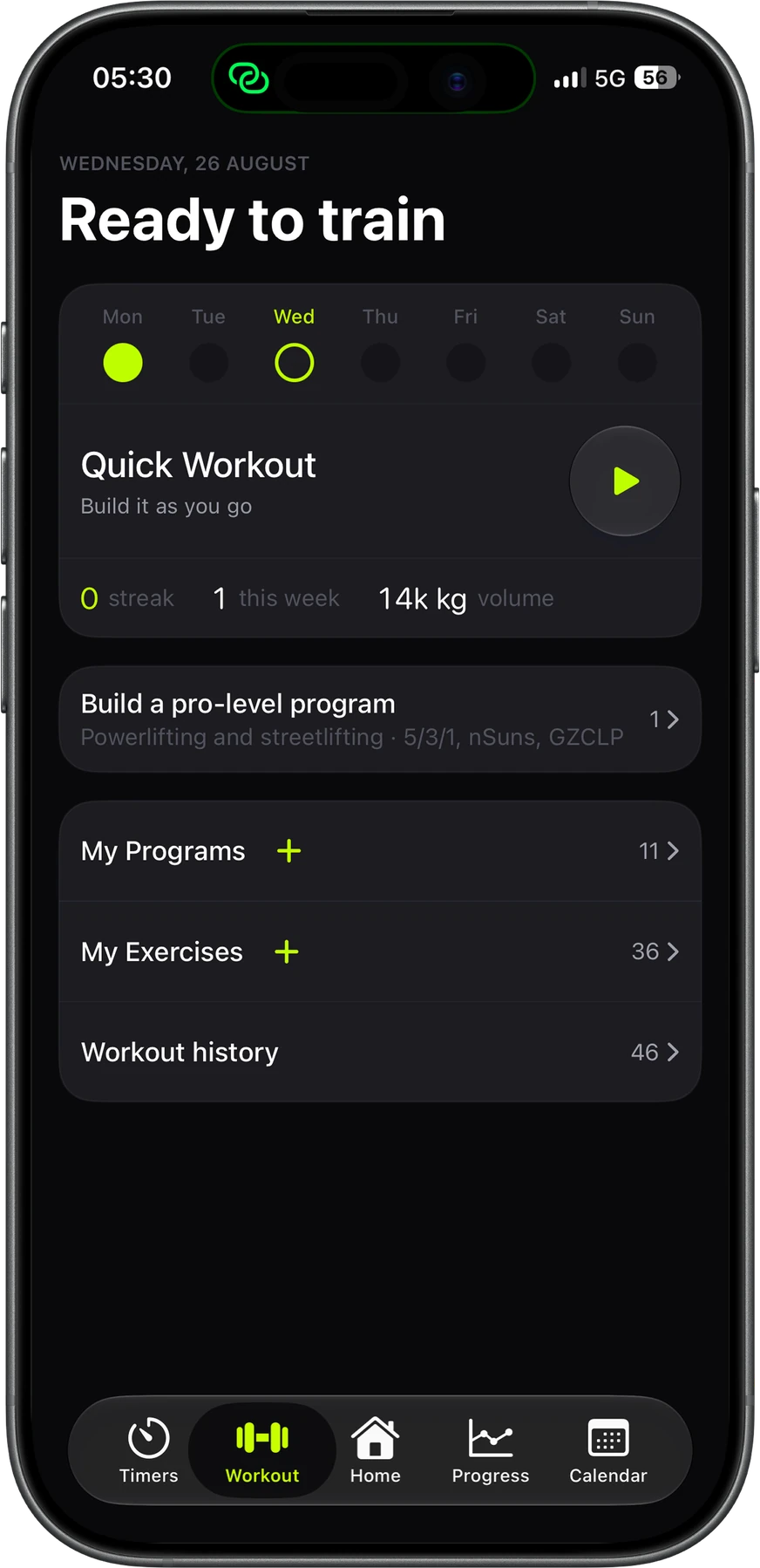
Strenos runs GZCLP three or four days a week with two, four or six lifts. Every workout comes with T1, T2 and assistance, weighed out for your plates. Log your sets, and Strenos decides whether the weight goes up or the lift moves to its next stage.
- The A1, B1, A2, B2 rotation is laid out for you
- Stages and restarts by the GZCLP rules
- Weighted pull-ups and dips work too
Free on the App Store. Week one of GZCLP is free.

On a computer? Point your iPhone camera at the code to open Strenos in the App Store.
Questions about GZCLP
How heavy do I start?
T1 starts at 85% of your 5-rep max, which is about 73% of your 1RM. T2 starts at about 55% of your 1RM. Strenos works out both from the max you enter.
How many days a week?
Three or four. The rotation just keeps going, so with three workouts a week, A1 lands on a different day each week.
Do I need an even number of lifts?
Yes. In Strenos you pick two, four or six. Lifts go in pairs, and each pair swaps T1 and T2 every other workout.
What counts as a failed stage?
Falling short of the stage's total reps across all its sets. Extra reps on the last set count toward it.
Can I run GZCLP with weighted pull-ups and dips?
Yes. Strenos counts your bodyweight in the percentages and adds weight one plate at a time. Pick six lifts in the calculator to add them.
Does the calculator match the app?
Yes. It uses the same rules for starting weights, stages and restarts, and we checked it against the app's code.
Is it free?
The first week is free in Strenos. The full program, your whole history and every chart come with Plus, which you can get monthly, yearly or as a one-time Lifetime purchase.
Is this the official GZCLP app?
No. Strenos isn't affiliated with Cody Lefever. It runs the GZCLP progression he published, with the one difference described above.
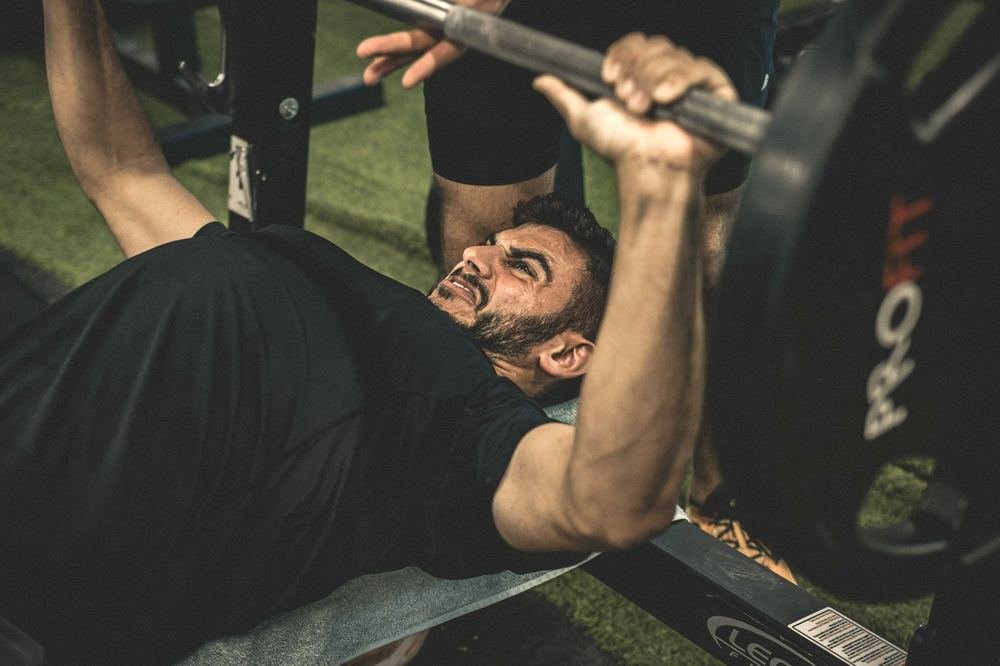

Your next set is already worked out.
Strenos runs five programs on iPhone and Apple Watch. You log sets on your wrist, and the weights are ready before you chalk up.
Free on the App Store.