 strenos
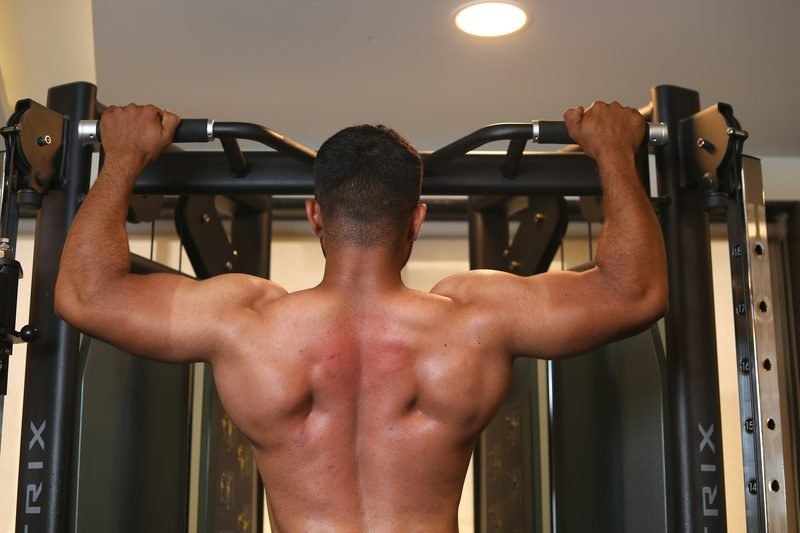
A weighted pull-up program is a regular strength program with a dip belt in place of the bar. Start adding weight once your strict reps from a dead hang are solid. Then run 5/3/1, nSuns, GZCLP or the Texas Method off your belt max, take every percentage from bodyweight plus belt, and move the belt up one small plate at a time. Train weighted dips next to it, with the same math.
Below, every number belongs to one lifter: you weigh 175 lb, your best pull-up is +90 lb, and your gym has 2.5 lb plates.
When to start adding weight
There's no official number. Published programs put the gate in different places:
- StrengthLog's beginner streetlifting program asks for 5–8 strict pull-ups and 8–10 dips with good form before you start. Its intermediate program asks for 12+ pull-ups and 15+ dips.
- Jim Wendler's method for weighted chins starts from a belt weight you can very easily do for 5 sets of 10.
Why add weight at all? A 2017 meta-analysis of 21 studies (Schoenfeld and colleagues) found that heavy loads built more 1RM strength than light loads taken to failure, while muscle growth was about the same. If you want a heavier pull-up, the load has to go up at some point.
What counts as a rep
The ISF rules (version 5.2, October 2026) start a pull-up from a full dead hang with straight arms and no swing. The rep ends with your chin over the bar, lower jaw above it. Overhand or underhand grip is fine, kipping and kicking are not. FinalRep describes the same lift: a dead hang to the chin clearly above the bar.
For dips, ISF wants your shoulder joint down to elbow level or lower, under control, then a full lockout.
This matters even if you never compete. Count half reps and your max grows on paper, and every belt weight built on it is too heavy to pull strict.
Pick a program that runs on the belt
Four classic percentage programs carry over to the belt. Here's how each moves the weight, and its first heavy set at +90 lb:
| Program | How the weight goes up | First heavy set |
|---|---|---|
| 5/3/1 | Your working max is 90% of your max. Three weeks of waves and a deload, then the working max goes up | +40 lb for 5+ |
| nSuns | Nine sets per lift each day. Your reps on the 1+ set at 95% set next week's working max | +57.5 lb for 1+ |
| GZCLP | The weight goes up after every session you hit your reps. A miss moves you to the next stage at the same weight | +32.5 lb, 5×3+ |
| Texas Method | Volume day 5×5, light day 2×5, heavy day 1×5. A new heavy five moves everything up | +57.5 lb for 5 |
Smolov Jr is the one that doesn't carry over. It was written for the barbell, and nobody has a reliable belt version. Copy its percentages onto the belt and the "easy" 70% day turns into a near-max one.
New to the belt and still getting stronger every session? GZCLP adds weight for as long as that lasts, and the r/Fitness wiki calls it a beginner-level linear progression. 5/3/1 is slower and steadier. For the full comparison, see which strength program to run.
Count your bodyweight in every percentage
On a pull-up you lift your body plus the plates, so every percentage has to come from that total. Take it from the plates alone and every set lands heavier than the program intends. Look at your week 1 top set. Your working max is +80 lb, and 85% of the plates is +67.5 lb, which is 91.5% of everything you can pull. The program weight with bodyweight counted is +40 lb, or 81%. The full math is in weighted pull-up percentages.
The short answerRun a normal percentage program on your belt max, count your bodyweight in every set, and move up one small plate at a time.
The belt moves one plate at a time
A barbell needs a pair of plates for every jump, one on each side. A belt takes them one at a time, so your smallest step is half the barbell's. With 2.5 lb plates, the bar goes up 5 lb and the belt 2.5 lb.
GZCLP shows it best. It adds 5 lb per session to upper-body barbell lifts. On the belt that becomes one 2.5 lb plate, so your heavy-tier (T1) pull-up goes +32.5, +35, +37.5, +40 over four good sessions.
Percentages round the same way, so +47.5 lb is a real belt weight even though no barbell can jump 2.5 lb.
Warm up without wasting sets
A belt warm-up can be short:
- One set at bodyweight. 12 reps if you weigh under 165 lb, 10 up to about 198 lb, 8 if you're heavier. Never more than half of your best bodyweight set.
- 20% of your belt max for 5.
- 40% of your belt max for 3.
Round warm-up weights to 10 lb and drop any set that isn't lighter than your first work set. In week 3 that set is +25 lb, so you warm up with 10 at bodyweight and +20 lb for 5, and the 40% set (+40 lb) goes. In week 1 the first work set is only +12.5 lb, so the bodyweight set is the whole warm-up.
A sample week
Here's week 1 of 5/3/1 with weighted dips added, at a +135 lb dip max. Each lift gets one heavy day. On Friday both come back for 5 sets of 5 at the week's first working weight, which is FSL (First Set Last).
| Day | Lift | Warm-up | Work sets |
|---|---|---|---|
| Monday | Pull-up | 10 at bodyweight | +12.5×5, +25×5, +40×5+ |
| Wednesday | Dip | 10 at bodyweight, +30×5 | +45×5, +60×5, +75×5+ |
| Friday | Pull-up and dip | Same as Monday and Wednesday | Pull-up 5×5 at +12.5, dip 5×5 at +45 |
In weeks 2 and 3 the pull-up top sets climb to +47.5 lb for 3+ and +57.5 lb for 1+. On dips they're +85 lb for 3+ and +95 lb for 1+. Week 4 is a deload. Put your squat or deadlift on any of these days.
Dips are the other half
In ISF classic streetlifting, your total is your best pull-up plus your best dip. Even if you never compete, the pair balances the week with one pull and one push on the same belt. Everything above applies to dips, with their own max and their own standard.
Common mistakes
- Counting reps a judge would throw out. A bent-arm start, the chin short of the bar, a kick at the bottom. Your max inflates, and the program follows it.
- Barbell-sized jumps. Hanging two plates at once out of barbell habit doubles your step.
- A stale bodyweight. Cut or gain 10 lb and your total load changes. Log it.
- Maxing out to get started. You don't need a test day. One hard set of a few reps gives a usable max in the weighted pull-up calculator.
- Training in straps or gloves if you plan to compete. ISF bans both.
How Strenos handles weighted pull-ups
Strenos runs 5/3/1, nSuns, GZCLP and the Texas Method on weighted pull-ups and dips, but not Smolov Jr. Every set comes from your body plus belt through a streetlifting formula, with your latest bodyweight from the weight log or a workout. Belt weights land on the smallest plate in your gym, program steps on the belt are half the barbell's, and the warm-up is built as above.
On 5/3/1 your working max is 90% of your belt max. After the week 3 plus set, Strenos turns your reps into a new estimated max. Below 95% of your current max, the working max resets by 10%. From 95% to 100% it holds. Above that it moves to 90% of the new max. With a week 3 top set of +57.5 lb, 5 reps take the working max from +80 to +82.5 lb, 4 reps hold it, and 3 or fewer reset it to +72.5. If you don't log the plus set, the max doesn't grow.
If your belt max is under 60 lb (27.2 kg), Strenos suggests a rep-based method and asks how many strict reps you get at bodyweight. On Apple Watch you check off sets, and after a plus set you dial in your reps with the crown.